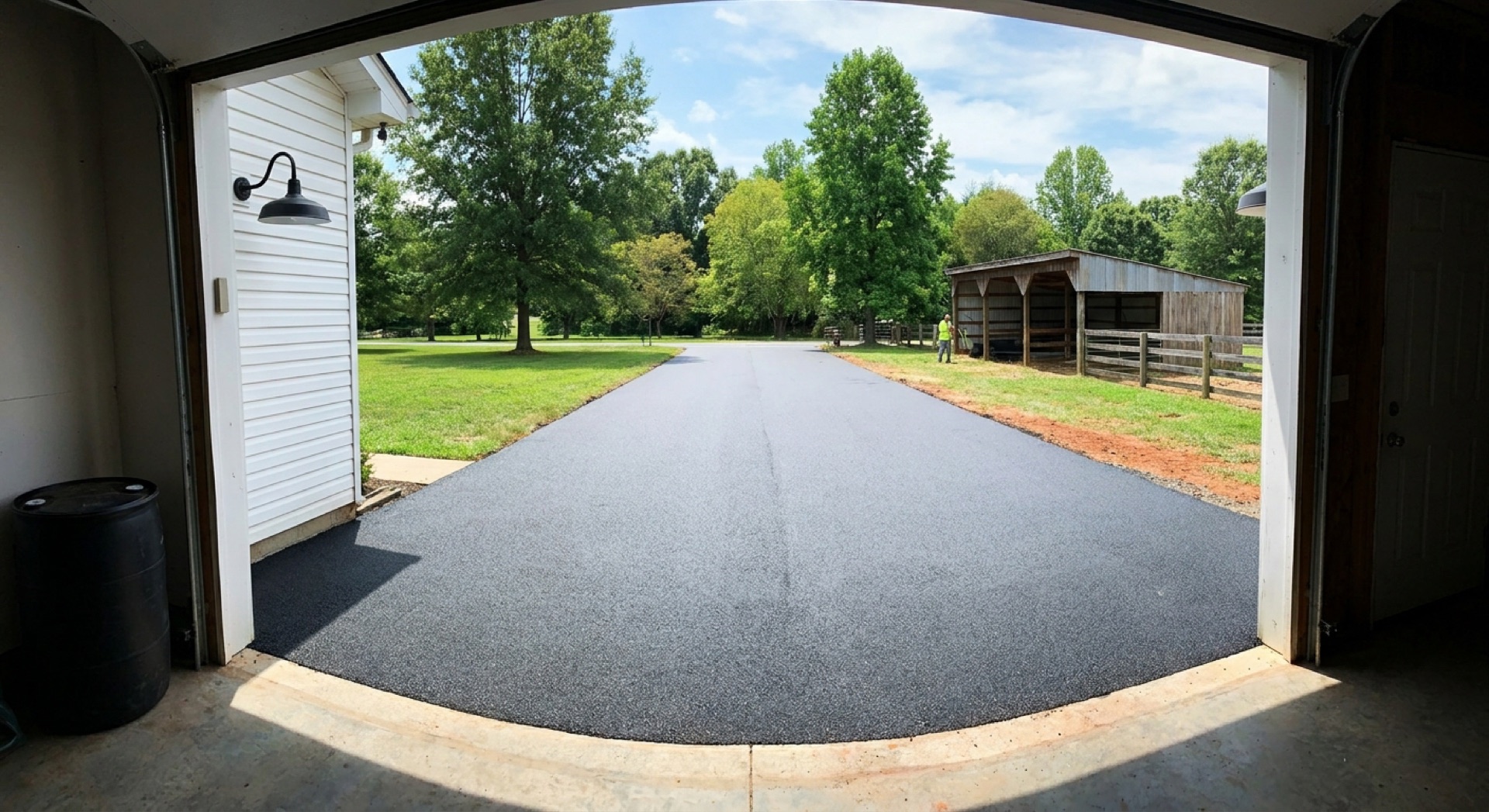
Leesburg Asphalt installs, replaces, and resurfaces asphalt driveways for homeowners throughout Loudoun County, VA — from Raspberry Falls estate driveways to standard two-car driveways in Lansdowne, Potomac Station, and Broadlands. We handle every scope: new installation over gravel, full replacement with base rebuild, resurfacing overlays, and driveway widening.
Leesburg Asphalt uses VDOT SM-9.5A Superpave surface course over a properly compacted 6–8" gravel base (21A or 21B crush-and-run) on every residential driveway — the same specification Virginia DOT requires on public roads. Typical cost: $4–$10 per sq ft. Most standard two-car driveways ($2,400–$6,000).
Free on-site estimate, written quote before any work begins.
Leesburg Asphalt paves residential driveways throughout Leesburg, VA and Loudoun County — DPOR Class A licensed, no subcontractors, proper 6–8" base on every job, most driveways completed in a single day.
From a single-car driveway in Sterling to a 400-foot private estate road in Selma Estates — Leesburg Asphalt handles every scope.
Full installation starting from graded subgrade through compacted 6–8" VDOT 21A base and 3"–4" SM-9.5A Superpave surface course. Common for new construction homes and properties converting from gravel. Edges cleanly defined.
Surface graded to drain away from the structure. Starts at $4/sq ft.
Full demolition of the existing failed driveway, haul-off of all debris, base rebuild, and new SM-9.5A hot-mix surface. The correct choice when alligator cracking covers more than 25% of the surface area or when base failure is confirmed. Most driveway replacements in Loudoun County run $2,400–$6,000 for a standard 600 sq ft driveway.
When the existing base is confirmed sound, we mill off the failed surface 1"–2" deep using cold planing equipment, apply a SS-1h tack coat at 0.08–0.15 gal/sq yd, then pave fresh SM-9.5A. Costs $3–$7/sq ft — roughly 40–60% less than full replacement. Extends driveway life 10–15 years when the base is solid.
Loudoun County has a higher concentration of large-lot properties than almost any other Virginia market — estate driveways of 200–1,000+ linear feet are common in Selma Estates, Raspberry Falls, and western Loudoun farm country. Leesburg Asphalt handles these from base design through final surface, including drainage design and VDOT entrance coordination where required.
Loudoun County's freeze-thaw cycles and clay soils accelerate asphalt deterioration faster than most homeowners expect. These warning signs mean repair or replacement — not another sealcoat.
Alligator or fatigue cracking — the interconnected web of cracks that resembles reptile skin — means the base layer has failed and can no longer support traffic load. This pattern cannot be fixed with crack filler or sealcoating. When alligator cracking covers more than 25% of the surface, full replacement with base rebuild is the only lasting solution.
Sealcoating over alligator cracking is money wasted — it will buckle and re-crack within one freeze-thaw season.
If the surface deflects or feels soft underfoot or under a vehicle, the base beneath has become saturated or structurally compromised. Loudoun County's clay soils expand when wet and drain slowly — base saturation is one of the most common failure modes here. Soft spots confirm subgrade or base failure that no surface-level repair can correct.
Replacement with drainage correction is required.
Rutting (wheel-path depressions) and shoving (rippling of the surface under traffic) both signal inadequate compaction or a mix design that can't handle load. Rutting depth greater than 0.5" accelerates water infiltration and creates a safety hazard. Shoving near the top of a slope or at stop points typically indicates base instability.
Both require removal and replacement of the affected section — surface patching will not hold.
A single pothole is a localized failure — hot-patch or infrared repair can fix it. But when potholes come back in the same locations year after year, the base in that zone can no longer hold. After two or three patching cycles in the same spot, full-section replacement is more cost-effective than continued patching.
Repeated repairs without addressing the underlying base failure is throwing money at a structural problem with a surface solution.
Raveling is the progressive loss of aggregate from the asphalt surface — you'll see loose stones and a rough, granular texture developing across the top. It starts where UV oxidation first breaks the bond between binder and stone. Early-stage raveling can be slowed with sealcoating.
Advanced raveling — where the surface has lost 3–5mm of material and feels like loose gravel — requires resurfacing to restore a sealed, load-bearing surface.
Properly maintained asphalt driveways typically reach end of service life at 25–30 years. If your driveway was installed in the late 1990s or early 2000s — the build-out era for most eastern Loudoun County subdivisions — it's approaching or past the point where maintenance spending exceeds replacement value. A failing 25-year-old surface with an unknown base history is almost always more cost-effective to replace than to keep patching and sealing.
We visit your property, measure the driveway, probe base conditions, and assess drainage. We quote only what's actually needed — not a phone estimate. Written itemized quote within 24 hours.
Remove existing surface with a skid steer, haul off all demo material same day. Install and compact 6–8" of VDOT 21A crush-and-run to 95% TMD. This is the most important step — the base determines how long the driveway lasts.
SM-9.5A Superpave hot-mix asphalt is placed while hot (275–325°F at laydown) and immediately compacted with a vibratory roller to 95% of theoretical maximum density. Edges are cleanly defined and the surface is graded for proper drainage. Same-day completion for most standard driveways.
Full site cleanup before we leave. We walk you through cure guidelines: drivable in 24–48 hours, full cure in 6–12 months. We advise when to schedule first sealcoating (6–12 months after installation).
Prices reflect Loudoun County market rates. Northern Virginia runs 25–35% above the Virginia state average due to labor costs. Final cost depends on base condition found during excavation.
Pricing reflects Loudoun County market conditions. Final cost depends on base conditions found during excavation. Leesburg Asphalt provides written itemized quotes after an on-site assessment.
Call (703) 382-5769.
Both materials pave well in Northern Virginia, but they differ significantly in upfront cost, climate performance, and long-term maintenance.
Leesburg Asphalt recommends what's right for your property — we never push the more expensive option when a simpler solution does the job.
Loudoun County presents a combination of environmental conditions that shorten asphalt driveway lifespans more than most Virginia homeowners expect. The county averages 30–40 freeze-thaw cycles per year during the November–March window. Each cycle drives water deeper into existing surface cracks, expanding them from the inside as it freezes and contracts as it thaws.
This mechanical stress is cumulative — driveways that survived 15 years in a warmer climate would see visible structural deterioration in 10–12 years here without the right base specification and regular sealcoating. Loudoun's clay-heavy soils compound this: clay retains water far longer than sandy or gravel soils, meaning the base layer stays saturated longer after each rain or snowmelt. Saturated base loses bearing capacity, and repeated vehicle loads on a compromised base are exactly how alligator cracking and rutting begin.
The regional market also creates a wide range of project types. Eastern Loudoun — Ashburn, Sterling, Broadlands, Brambleton — is dominated by planned communities built between 1985 and 2010, where original 1.5"–2" asphalt overlays are now reaching the end of their first service cycle. Central Loudoun — Leesburg, Lansdowne, Potomac Station, Cascades — mixes HOA communities with older residential stock.
Western Loudoun — Purcellville, Hamilton, Middleburg, Round Hill — features horse farm properties and rural estate driveways running 300–1,000+ linear feet over terrain that requires careful drainage design and sometimes VDOT entrance coordination. Leesburg Asphalt handles all three market types. Every job starts with an on-site assessment of base conditions — because in Loudoun County, the gravel depth you put down on day one determines everything that happens over the next 25 years.
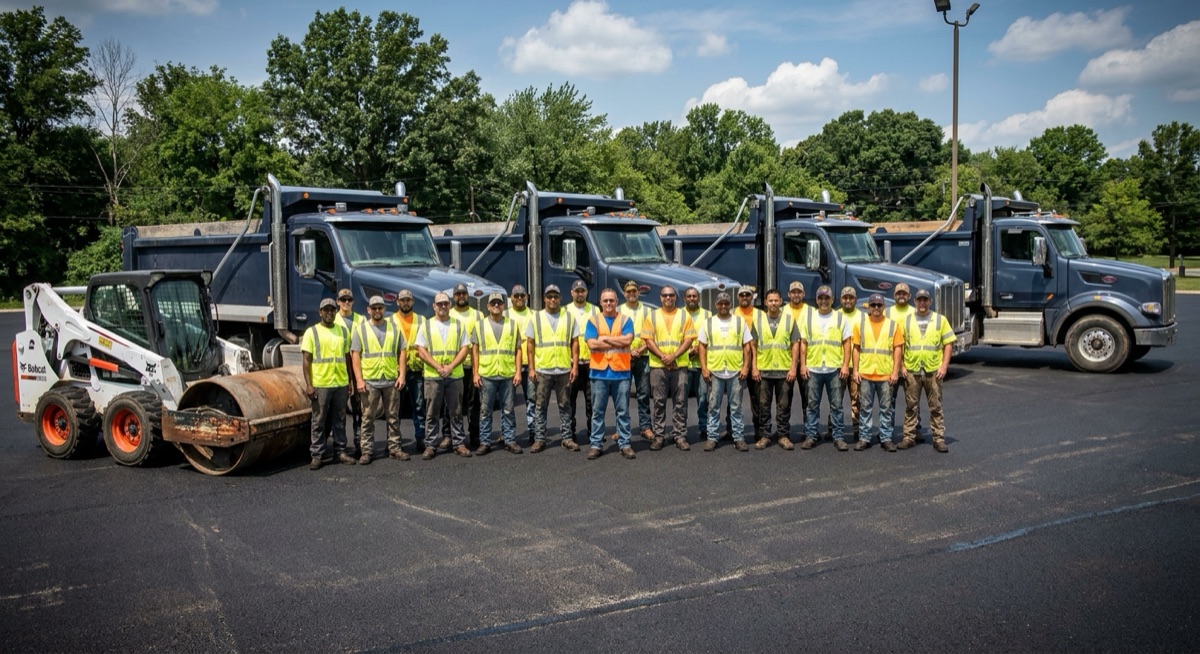
In Leesburg, a new asphalt driveway costs $4–$7 per square foot for a standard installation with a 3"–4" compacted SM-9.5A surface course over a prepared gravel base. Premium installations with regrading and thick base run $8–$10+ per square foot. A typical two-car driveway at 600 sq ft runs $2,400–$4,200 standard or $4,800–$6,000 premium.
Larger estate driveways in Raspberry Falls and Selma Estates (1,500–3,000+ sq ft) scale proportionally but often come in lower per sq ft due to equipment efficiency.
Verify a DPOR Class A or B contractor license with the PAV (Asphalt Paving & Sealcoating) specialty — Virginia requires licensure for all paving work over $1,000. You can verify at dpor.virginia.gov. Ask for proof of liability insurance and worker's compensation.
Request a written estimate specifying what VDOT mix grade is used, base depth, and compaction method. Avoid contractors who give quotes over the phone without visiting the site, or who require full cash payment upfront.
The optimal window for driveway paving in Loudoun County is April through October, when consistent daytime temperatures stay above 50°F and the asphalt plant is producing at full capacity. Late spring (April–June) and early fall (September–October) are the two best windows: temperatures are moderate, cure conditions are ideal, and there's no risk of rain delay from summer thunderstorms. Avoid paving in November through March — cold asphalt cools too quickly after laydown, which prevents proper compaction to the 95% TMD target.
Hot summer paving (July–August) is fine but requires careful timing around heat and thunderstorm windows. Leesburg Asphalt schedules jobs across the full April–October season, with fall slots filling up fastest.