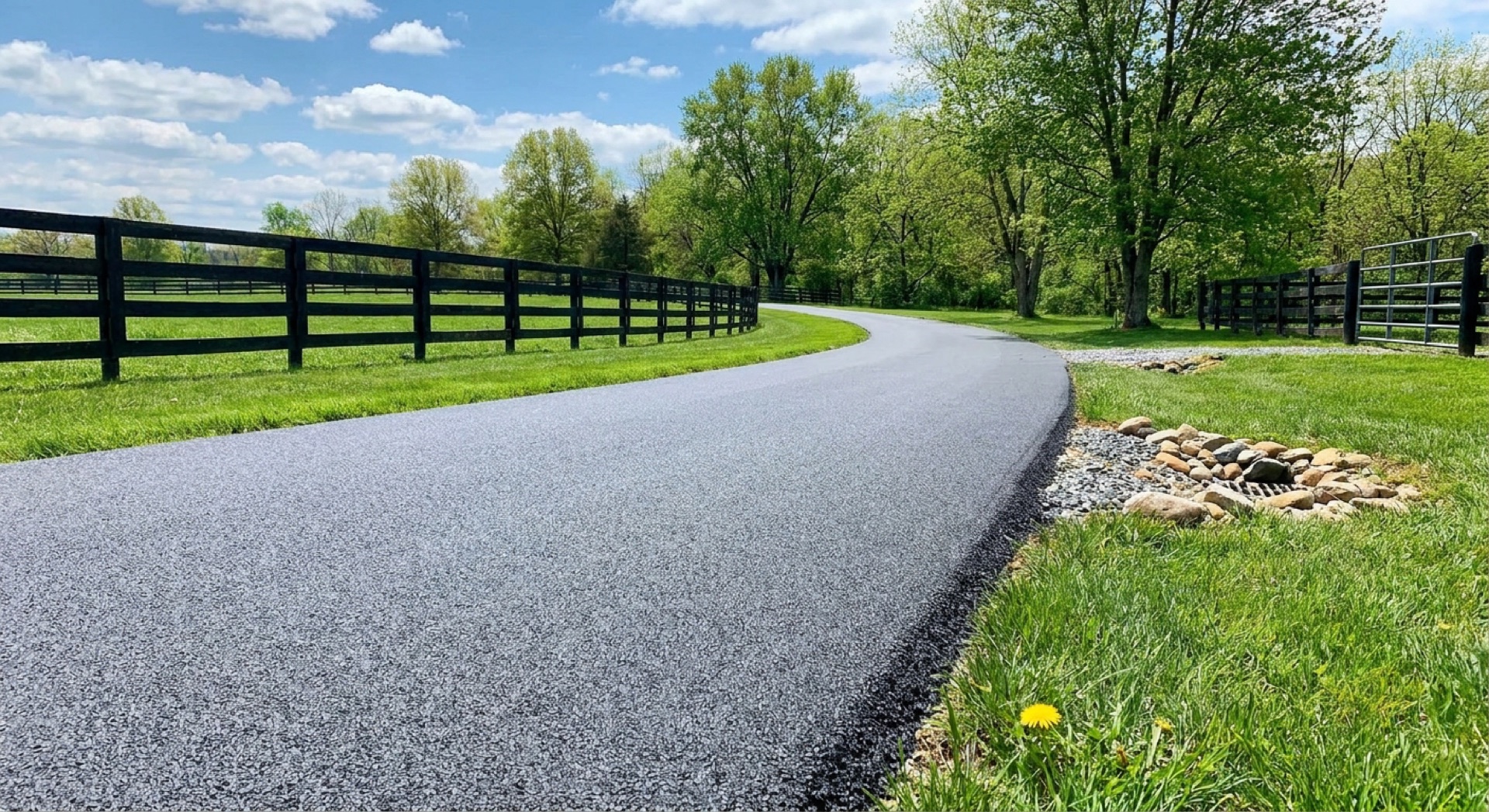
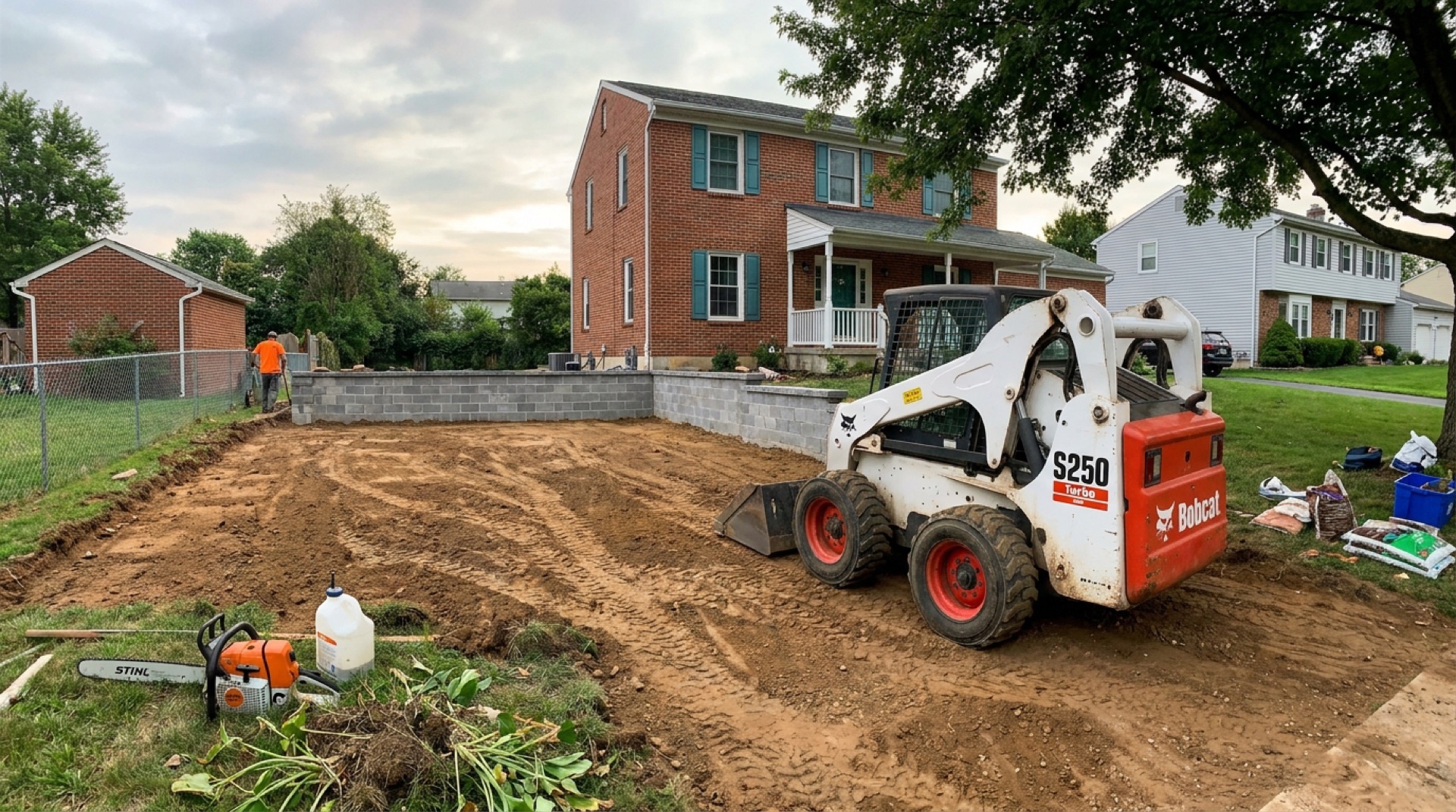
Leesburg Asphalt widens, extends, and reconfigures asphalt driveways for homeowners throughout Loudoun County, VA. Whether you need 2 extra feet on each side to open the door without stepping into grass, a full second lane for a two-car household, a parking pad for a third vehicle, or a turnaround at the end of a long driveway, we can expand your existing asphalt and match the new section to the existing surface so it looks like it was always there.
Driveway widening in Leesburg typically costs $1,500–$8,000+ depending on the footage being added and whether a sealcoating pass is done over the full driveway to blend old and new asphalt. SM-9.5A Superpave hot-mix is used to match existing driveway thickness. Free estimates throughout Loudoun County.
Leesburg Asphalt widens and extends driveways throughout Loudoun County, VA — matching the new asphalt section to the existing driveway in thickness, texture, and grade so the addition is virtually seamless.
The most common request: adding 2–4 feet to each side of an existing driveway to create more comfortable clearance between vehicles, or converting a single-lane driveway to two-lane. The new strip is excavated to match the existing asphalt depth (usually 2.5"–3"), VDOT 21A base material is placed and compacted if needed, SS-1h tack coat applied at the longitudinal joint, and SM-9.5A hot-mix placed and compacted flush with the existing surface. The joint is rolled to create a watertight seal.
Extending an existing driveway further back toward the garage or down a longer approach. Length extensions require careful grade matching — the new section must drain away from the house and connect to the existing driveway at a joint that won't allow water infiltration. We survey the grade before quoting to confirm the extension can be accomplished without pooling.
Most length extensions also require a new curb cut or apron connection if extending toward the street.
Adding a dedicated parking pad off the side of an existing driveway — for a third car, a boat, an RV, or a motorcycle. Typical parking pad size: 10'×20' for a single car, 20'×20' for two cars side-by-side. The pad connects to the existing driveway at a flair connection so vehicles can swing in and out without tight maneuvering.
Proper base preparation (6"–8" VDOT 21A compacted base) is critical for parking pad longevity under static vehicle weight.
Long driveways in rural Loudoun often terminate without enough space to turn around — backing out to the road is inconvenient and dangerous. We add asphalt turnarounds (circular or Y-shaped hammerhead configuration) at the garage end or midpoint of long driveways. Minimum turnaround radius for a standard passenger vehicle: 12–14 feet.
For trucks and SUVs: 18–20 feet. For multi-point turns only: a hammerhead of 10' depth on each side of the driveway provides a 3-point turn capability.
Many Loudoun County driveways built in the 1980s and 1990s were sized for the vehicles of that era — a single-car standard that doesn't work for today's households. These signs indicate the current width isn't working.
If you or your family members routinely drive partially on the grass edge when pulling in or backing out, the driveway width is functionally inadequate. Modern full-size SUVs, trucks, and minivans are 6.5–7 feet wide at the mirrors — on a 9-foot driveway, there's less than a foot of clearance on each side. Over time, repeatedly driving on the grass edge damages the driveway's perimeter through lateral support loss, and creates a rut in the lawn that compounds into edge raveling of the asphalt.
Widening adds a permanent solution vs. the ongoing property damage from straying off the edge.
A standard car door requires approximately 2.5–3 feet of clearance to open fully — more for full-size trucks and SUVs. On a 9–10 foot driveway, a parked vehicle in the center leaves less than 2 feet on each side: enough to open a door, but not enough to step out without stepping off the driveway surface. The practical result is muddy shoes, wet feet in rain, and difficulty loading groceries or getting children out of car seats.
Widening to 12–14 feet creates comfortable door-open and step-out clearance on both sides without touching the grass.
New drivers in the household, a second adult vehicle, or a third car after a major life change (new job, new teenager) creates a parking demand that a single-lane driveway wasn't designed for. Parking a second car in the garage works if the garage can accommodate it, but most Loudoun County single-car garages from the 1980s–2000s were built to 10–12 feet wide — tight for modern vehicles. Adding a second lane, a side parking pad, or a widened apron area with room for two vehicles solves the parking problem without the cost and disruption of a garage addition.
Long driveways in rural Loudoun — particularly in Purcellville, Hamilton, and the western counties — that terminate at the garage without a turnaround area require backing out to the road, which is both inconvenient and hazardous when the driveway meets a rural road without good sight lines. Adding a hammerhead (T-shaped turnaround) or circular turnaround at the end of the driveway eliminates the daily inconvenience and the safety exposure. Loudoun County Fire Code also addresses emergency vehicle access — if fire apparatus cannot turn around on your property, a turnaround addition may be code-required during a future renovation permit.
A full-size RV is typically 8.5 feet wide and needs 10–12 feet of clearance for maneuvering. A boat on a trailer is 8–10 feet wide. Work trucks and equipment trailers are routinely wider than passenger vehicles.
If you've recently acquired a larger vehicle or trailer that doesn't fit comfortably on the current driveway, a widening or parking pad addition resolves the fit problem permanently. We assess the vehicle's turning radius requirements at the estimate visit to ensure the expansion design accommodates the specific vehicle you need to park.
Driveway width is consistently cited by Loudoun County real estate agents as a factor buyers notice during walkthroughs. A driveway that's too narrow to comfortably park two cars side-by-side is a functional deficiency that buyers register consciously or subconsciously. Widening a 10-foot driveway to 18–20 feet before listing costs $3,000–$6,000 and eliminates a friction point in the buyer evaluation.
Combined with a full-driveway sealcoat for fresh appearance, the curb appeal improvement often yields more than its cost in negotiating position on a Loudoun County home priced above $600,000.
We measure the existing driveway, confirm desired final dimensions, check setbacks from property lines (Loudoun County requires minimum 5-foot setback for most residential driveways), and layout the expansion area with stakes or chalk. If the expansion approaches the property line, we confirm setback compliance before proceeding. Utility locate (MISS UTILITY 811) is called minimum 3 business days before any excavation — required by Virginia law and critical for driveways in Loudoun County's suburban neighborhoods with buried irrigation, lighting, and utility lines.
Expansion area is excavated to match the existing asphalt depth — we probe the existing driveway edge to confirm thickness (typically 2.5"–3" for residential driveways). If the existing driveway has a full-depth base, the expansion area is excavated to the same total depth and VDOT 21A aggregate base is placed and compacted. Edge of existing asphalt is cleaned of grass and soil so tack coat can adhere to the vertical face.
Excavation for a typical driveway widening of 4 feet × 30 feet takes 1–2 hours.
SS-1h tack coat applied at 0.08–0.15 gal/sq yd to the prepared base and the vertical face of the existing asphalt edge. Allow 10–20 minutes to break (become tacky). SM-9.5A hot-mix is placed in the expansion area at the same depth as the existing driveway and compacted with a plate compactor and hand tamper at the longitudinal joint.
Finished surface is flush with the existing driveway — no hump, no low spot at the joint. Entire paving operation takes 2–4 hours for a typical widening project.
New hot-mix asphalt is jet black when fresh; the existing driveway may be gray or faded. The color difference between old and new sections fades over 2–3 seasons as the new asphalt oxidizes. To accelerate the blending and achieve a uniform appearance immediately, we offer a full-driveway sealcoating application 30 days after the widening is complete — by which time the new section has cured sufficiently to accept sealer.
A single sealcoating pass over the entire driveway produces a uniform dark finish that makes the addition invisible.
A single-car driveway should be minimum 10 feet wide for comfortable use (12 feet is better — allows the door to open fully without stepping off the edge). A two-car driveway should be 18–20 feet wide. If your driveway is currently 8–9 feet wide and you find yourself driving over the edge or scraping bushes on the side, widening to 12 feet makes a significant practical difference.
Most Loudoun County homeowners widening for a second car add 8–10 feet, creating an 18-foot total width.
New SM-9.5A asphalt is jet black when fresh. An existing faded gray driveway will show a visible color difference at the joint for 2–3 seasons while the new section oxidizes to match. If you want immediate color uniformity, schedule a full-driveway sealcoating pass 30 days after the widening — the sealer makes old and new sections indistinguishable.
Most homeowners who are considering resurfacing the existing driveway anyway choose to widen first, then resurface or sealcoat the entire area as one combined project.
Loudoun County's rapid residential growth from 1995 to 2015 produced tens of thousands of single-family homes with driveways designed to the standards of that era — typically 9–10 feet wide for single-car garages and 16–18 feet wide for two-car garages. In the intervening 10–30 years, vehicles have grown significantly larger. The average American passenger vehicle width increased from approximately 74 inches in 1990 to 79 inches in 2020, with full-size SUVs and trucks commonly exceeding 80 inches.
A 10-foot driveway that was comfortable for a 1995 compact car is genuinely tight for a 2025 full-size SUV. Leesburg Asphalt sees consistent demand from eastern Loudoun homeowners in Ashburn, Sterling, Cascades, and South Riding where the 1995–2010 build-out produced homes with 10-foot single-lane driveways that no longer match the household's vehicle mix.
Western Loudoun's widening demand is different in character — the request is more often for turnarounds, parking pads for farm equipment or recreational vehicles, or full second-lane additions to rural estate driveways that were built for a single-vehicle approach in an era when the property was less intensively used. For properties where a 20-year-old gravel driveway is being paved in asphalt, the widening can be incorporated into the initial paving project at minimal additional cost — it's far cheaper to pave the correct width during original construction than to return and widen later. Leesburg Asphalt routinely flags this opportunity when quoting gravel-to-asphalt conversions in western Loudoun and recommends sizing the initial paving to the household's actual vehicle mix rather than the minimum functional width.
Driveway widening in Leesburg typically runs $5.00–$12.00 per square foot for the added area, depending on excavation depth, base requirements, and access. A narrow widening of 2 feet per side × 30 feet (120 sq ft total) costs approximately $1,500–$3,000. Converting a single-lane 10-foot driveway to an 18-foot two-car driveway (adding 8 feet × 30 feet = 240 sq ft) runs approximately $3,000–$6,000.
Parking pad additions (200 sq ft) run $2,500–$5,000. Adding a full-driveway sealcoating pass for color blending adds $350–$1,200.
Most residential driveway widenings in Loudoun County don't require a permit if the widening doesn't add new impervious area that triggers stormwater requirements and doesn't change the curb cut at the street. However, if the widening expands the total impervious area of the lot by more than 2,500 sq ft, or if the driveway approaches a stream buffer (RPA), land disturbance permits or environmental reviews may be required. We assess permit requirements at the free estimate visit.
Curb cut modifications (where the driveway meets the public road) require a separate entrance permit from Loudoun County DTCI.
Loudoun County's Revised 1993 Zoning Ordinance generally requires driveways to maintain a minimum 5-foot setback from the side property line in most residential zoning districts. HOA covenants may impose additional restrictions — some HOAs in Loudoun require up to 10 feet setback. Before marking out the expansion area, we review the county setback requirements and ask if your property is in an HOA with its own standards.
We won't proceed with work that would require you to remove it later due to a setback violation.
Most residential driveway widening projects are completed in a single day. Excavation and base preparation takes 1–3 hours. Tack coat and paving takes another 2–4 hours.
The driveway is open to foot traffic immediately and to vehicles within 2 hours as the hot-mix cools. For projects combined with full driveway resurfacing or sealcoating, add 1 additional day for the related work. MISS UTILITY utility locate must be requested minimum 3 business days before the dig date — plan accordingly when scheduling.
Longitudinal joints between existing and new asphalt are a potential weakness — if not properly constructed, they can develop a crack along the joint within 1–3 years. Proper joint construction requires: (1) cleaning the vertical face of the existing asphalt so it's free of soil and organic material, (2) applying SS-1h tack coat at 0.08–0.15 gal/sq yd to the vertical face and prepared base, (3) placing hot-mix asphalt against the tacked vertical face and compacting the joint with a steel-drum roller to achieve fusion between old and new material. Done correctly, a longitudinal joint is no more likely to crack than any other part of the surface.
Done incorrectly (no tack coat, dirty existing face, hand-tamped only), it will crack. Leesburg Asphalt uses a vibratory steel drum roller on all longitudinal joints — not just a plate compactor, which doesn't achieve the density needed for a waterproof joint.