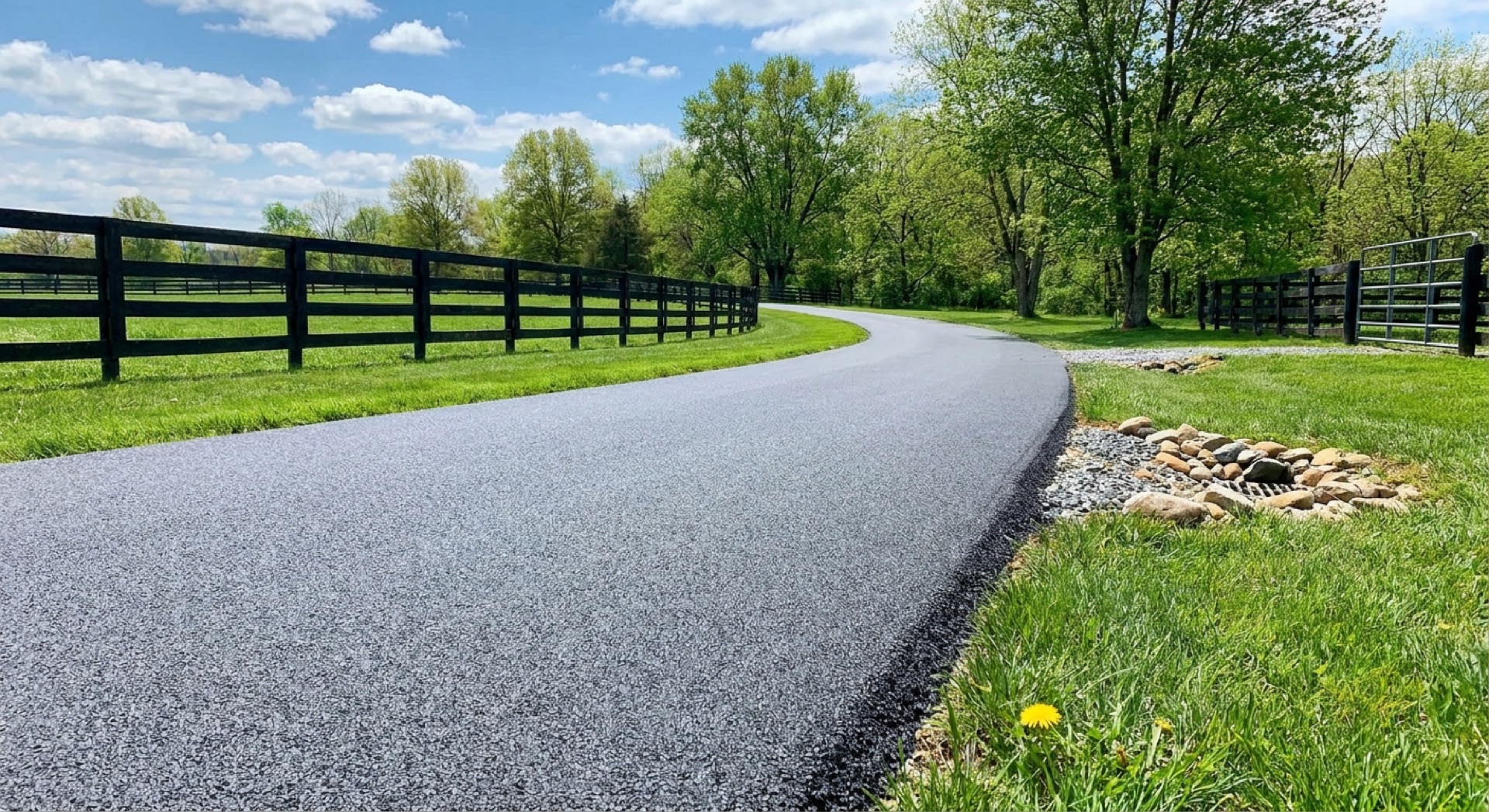
Leesburg Asphalt installs chip seal driveways (also called tar-and-chip or macadam) for homeowners in Loudoun County who want the look of natural stone aggregate on a solid bound surface — at significantly less cost than smooth hot-mix asphalt. Chip seal is applied by spraying liquid asphalt emulsion on a prepared aggregate base, then immediately rolling crushed stone aggregate into the hot emulsion. The resulting surface is textured, durable, and naturally attractive — especially on rural estate properties in Purcellville, Middleburg, Hamilton, and the western Loudoun countryside.
Chip seal driveways in Leesburg typically cost $1.50–$4.00 per square foot — significantly less than smooth hot-mix asphalt at $4–$10 per square foot. Most suitable for rural and estate driveways 400 sq ft or larger with good existing base preparation. Free estimates throughout Loudoun County.
Leesburg Asphalt installs chip seal driveways throughout Loudoun County, VA — the right aggregate for the application, proper emulsion coverage rate, and enough experience with Virginia's weather to schedule installation on days when success is guaranteed.
Standard chip seal for residential driveways with a sound gravel base. One application of liquid asphalt emulsion at 0.25–0.35 gal/sq yd, followed immediately by crushed stone spread at 20–25 lbs/sq yd and rolled into the emulsion. Surface life: 5–10 years depending on traffic, weather, and maintenance.
Best suited for driveways under 2 vehicles/day use. Surface texture is rougher than smooth asphalt — the trade-off for the natural look and lower cost.
Two-coat chip seal for higher-traffic driveways and long rural access roads. First coat applies emulsion and No. 57 stone (larger aggregate), rolled and cured. Second coat applies a lighter emulsion layer and No. 8 stone (smaller aggregate) to fill voids and create a tighter, more uniform surface.
Double-coat chip seal provides significantly better durability than single-coat and is recommended for any driveway with 3+ vehicles/day. Surface life: 7–15 years. Cost premium over single-coat: approximately 60–80%.
Unlike smooth black asphalt, chip seal lets you choose your stone color to complement your property. Common options in Loudoun County: grey crushed limestone (the most common — neutral, classic), brown-grey granite (warmer tone, blends with red brick homes), tan flint (lighter color, excellent for formal approaches to historic properties), and blue-grey diabase (bold color, used in some Middleburg-area estates). Stone color fades slightly over time as dust accumulates in the texture.
Converting a gravel driveway to chip seal is the most budget-conscious way to get a paved surface in rural Loudoun. The existing gravel is shaped and compacted to provide a stable base — most gravel driveways with 4"+ of compacted stone can be chip sealed directly over the existing stone after grading. This skips the cost of aggregate base demolition and disposal.
Result: a semi-permanent paved surface that looks natural in a rural landscape and eliminates dust, washout, and stone replenishment costs.
Chip seal isn't the right solution for every driveway — but for rural and estate properties in Loudoun County, it's often the ideal upgrade from gravel or a cost-effective renewal for an aging chip seal surface.
Gravel driveways on Loudoun County's Piedmont clay soils require stone replenishment every 1–2 years because clay provides poor lateral retention — stone migrates off the edges and is displaced by vehicle tires. A driveway that required stone delivered and graded in 2023 and needs it again in 2025 has reached the cost break-even point where chip seal pays for itself in 5–7 years through eliminated annual stone costs. Chip seal over a properly graded gravel base binds the surface permanently — no more hauling, no more grading, no more stone migration.
A chip seal surface that has been in place 7–12 years often shows patchy aggregate coverage — areas where stone has been knocked free by traffic, leaving exposed emulsion that has oxidized brown. When more than 20–30% of the surface area shows bare spots or heavily thinned aggregate coverage, a re-chip (fresh top coat) application restores the surface. Re-chipping is significantly less expensive than full removal and replacement — the existing surface provides a stable foundation and only a new emulsion and aggregate layer are needed to restore appearance and protection.
A gravel or dirt driveway in rural Loudoun that produces mud tracked into the house and garage after every significant rain, or that washes out and develops ruts in the same locations season after season, has a drainage problem that gravel alone can't solve. Chip seal over a properly graded and compacted base creates a sealed, waterproof surface that sheds rain off to the sides and eliminates the erosion that produces mud. The chip seal surface is also easier to keep clean in wet weather — a quick sweeping or rinse removes surface mud without disturbing the bound aggregate.
For a 500-foot rural driveway in western Loudoun, hot-mix asphalt at $4–$8 per square foot for a 12-foot-wide road would cost $24,000–$48,000. Chip seal of the same area at $1.50–$3.00 per square foot costs $9,000–$18,000 — a savings of $15,000–$30,000 for essentially the same functional result: a paved, dust-free, weatherproof surface that needs no annual stone replenishment. For estate driveways in Purcellville, Middleburg, and Round Hill where 400–1,200 feet of approach is common, chip seal makes permanent paving economically viable where hot-mix would not.
For historic farms, equestrian properties, and rural estates in western Loudoun County — particularly near Middleburg, Waterford, and the horse country south of Route 7 — the natural stone texture of chip seal complements the property's aesthetic in a way that smooth black asphalt does not. Virginia Board of Historic Resources guidelines for properties within historic districts or viewsheds sometimes actually recommend chip seal over hot-mix for driveway paving. Leesburg Asphalt offers three stone color options (grey limestone, brown granite, tan flint) so the aggregate can be selected to complement the home's exterior palette.
A gravel or deteriorated chip seal driveway is a visible negative first impression on a rural Loudoun property listing. A fresh chip seal application dramatically improves curb appeal at a fraction of the cost of new asphalt — particularly for long approaches where the investment in hot-mix would be substantial. Real estate agents working the Middleburg, Purcellville, and Hamilton markets consistently report that buyers react more favorably to a neat chip seal driveway than to a rough gravel approach, even for horse properties where gravel is common.
A fresh chip seal is a staging investment with clear listing ROI for rural Loudoun properties priced above $750,000.
We assess the existing base — gravel driveways must have at least 4" of compacted stone, and the surface must be dry. Any soft or wet spots are addressed with additional base material and compaction. The base is graded to establish proper crown (1/4"–3/8" per foot for drainage) and any edge boards or border stones are set.
Base prep is the most critical factor in chip seal durability — a poorly prepared base causes the emulsion to penetrate unevenly and produces loose stone. Takes 1–4 hours depending on driveway length.
Liquid asphalt emulsion is sprayed at 0.25–0.35 gal/sq yd using a distributor truck calibrated to the specified coverage rate. The emulsion must be applied at the correct temperature (typically 130–160°F) and immediately followed by stone — the window between emulsion application and stone placement is 3–5 minutes. Application requires minimum 50°F air temperature and no rain for 4+ hours before and after.
Driveway must be dry — even dew on the surface can cause adhesion failure.
Angular crushed aggregate (No. 8 for single-coat, No. 57 for double-coat first layer) is spread at 20–25 lbs/sq yd immediately behind the emulsion distributor. A pneumatic roller then embeds the stone into the hot emulsion in the same pass. The pneumatic roller's knobby tires work the stone into the emulsion from multiple contact angles, achieving embedment depth of approximately ½ the stone diameter.
Rolling is complete in 2–3 passes. Driveway closed to traffic for 24 hours after application.
After 24–48 hours of curing, a rotary broom sweeps excess loose stone that hasn't bonded to the emulsion. Some loose stone is normal during the first 2–4 weeks — drive slowly (under 15 mph) for the first month and avoid sharp turning movements that pull stone free. Loose stone can scratch vehicle paint if thrown by tires at speed.
The surface tightens and stabilizes over the first season as traffic embeds remaining stone. Sealcoating every 5–7 years maintains the surface.
Chip seal is the most common paved driveway surface in western Loudoun County's rural residential market — the communities of Purcellville, Hamilton, Round Hill, Lovettsville, and Waterford account for a disproportionate share of Leesburg Asphalt's chip seal work because these towns contain a high concentration of large-lot rural residential properties with long driveways. The typical chip seal candidate in western Loudoun is a 400–800 foot gravel approach to an estate home built in the 1980s–2000s that has been replenished with gravel multiple times and is ready for a permanent paved surface. The western Loudoun soil profile — predominantly Piedmont red clay and weathered granite — retains moisture and becomes unstable when saturated, which is why gravel driveways on these soils shed stone faster and produce more mud than driveways on the faster-draining sandy soils of eastern Loudoun.
For these properties, chip seal provides the structural permanence that gravel can't achieve and the cost advantage that makes it viable where asphalt would not be.
In eastern Loudoun's suburban communities — Ashburn, Sterling, Cascades, South Riding, Brambleton — chip seal is less common because the shorter driveway lengths make hot-mix asphalt cost-competitive, and HOA covenants in many master-planned communities specify smooth asphalt for driveways. When chip seal is appropriate in eastern Loudoun, it's typically for a property with a long side yard access or a secondary access drive that the homeowner wants to pave without the cost of full hot-mix. Leesburg Asphalt assesses each chip seal project individually: if the property's HOA documents restrict surface type, we flag it at the estimate visit before the project is contracted.
Western Loudoun properties generally have no HOA restrictions and significant latitude for surface choice — chip seal with grey limestone aggregate is well-accepted and even expected on rural estate properties in those communities.
Single-coat chip seal in Leesburg runs $1.50–$2.50 per square foot; double-coat runs $2.50–$4.00 per square foot. A standard 800 sq ft driveway costs $1,200–$3,200 for chip seal — compared to $3,200–$8,000 for the same area in smooth hot-mix asphalt. Long rural driveways (3,000–6,000 sq ft) cost $4,500–$24,000 for chip seal vs. $12,000–$60,000 for hot-mix.
Additional base material ($25–$45/ton) may be needed if the existing gravel base is under 4" compacted depth.
Single-coat chip seal lasts 5–10 years; double-coat lasts 7–15 years. Longevity depends on traffic volume, base quality, drainage, and weather exposure. Chip seal is not a maintenance-free surface — loose stone is common in the first season, and the surface benefits from a re-chip (top coat) every 5–7 years to restore the aggregate cover and emulsion binder.
Unlike smooth asphalt, chip seal doesn't need crack sealing or sealcoating in the same way — the re-chip application handles surface renewal.
Loose stone is most prevalent in the first 2–4 weeks after a new chip seal installation. During this break-in period, drive slowly (under 15 mph) and avoid sharp turning movements. Excess loose stone is swept after 24–48 hours, but some stone will continue to work its way to the surface for the first season.
After the first full season of traffic, the surface stabilizes significantly. This is a characteristic of chip seal, not a defect — homeowners with chip seal driveways are accustomed to this. If zero loose stone is a requirement, smooth hot-mix asphalt is the right choice.
Yes — chip seal can be applied over existing smooth asphalt as a resurfacing treatment, providing a fresh aggregate surface and renewed waterproofing at a cost significantly below full resurfacing. The existing asphalt must be sound (no alligator cracking or base failure) and any potholes or deep cracks must be repaired first. The chip seal emulsion bonds well to smooth asphalt provided the surface is clean and dry.
This is occasionally used on older driveways where the homeowner wants to extend surface life without the cost of full resurfacing.
The most popular stone color for chip seal driveways in Loudoun County is grey crushed limestone — it's neutral, pairs with nearly every home exterior color, and is the most widely used surface in western Loudoun's rural communities. Brown-grey granite is a warmer alternative that works particularly well with red brick homes or warm-toned exteriors. Tan flint creates a lighter, more formal appearance that's common on historic properties in and around Middleburg and Waterford where a bright white or cream stone complements older architectural styles.
Blue-grey diabase is less common but gives a striking appearance. We bring stone color samples to estimate visits in western Loudoun so homeowners can compare before committing — the color difference between limestone and granite is subtle in a photo but visible in person next to the home.
In western Loudoun's rural residential areas — Purcellville, Hamilton, Round Hill, Lovettsville, Waterford, and rural Middleburg — HOA covenants are uncommon and chip seal is a freely permitted surface choice. In eastern Loudoun's master-planned communities (Ashburn Farm, Cascades, Brambleton, South Riding, etc.), HOA design standards typically specify smooth asphalt or concrete for residential driveways and may prohibit chip seal. Before contracting chip seal work, Leesburg Asphalt asks at the estimate visit whether the property is in an HOA with design review authority.
If HOA approval is needed, we provide a written project description and product specification the homeowner can submit with their architectural review request. We don't start work until HOA approval is confirmed.