Private Road Paving in Leesburg, VA

Rural Estate Lanes · Subdivision Roads · Long Driveways

Leesburg Asphalt paves private roads, long rural driveways, shared access lanes, and subdivision entrance roads throughout Loudoun County, VA. Private road paving in rural Loudoun — Purcellville, Middleburg, Hamilton, Round Hill, Lovettsville, Waterford — is one of our specialties. We handle the full scope: site clearing assessment, grading, VDOT 21B aggregate base construction, and SM-9.5A Superpave asphalt paving.

Private roads range from 200-foot rural driveways to quarter-mile shared access roads serving multiple estate parcels.

Private road paving in Loudoun County typically runs $8–$18 per linear foot for a 12-foot-wide road, or $3.00–$6.00 per square foot, depending on road width, base condition, drainage requirements, and distance from the nearest asphalt plant. Free on-site estimates — we travel to rural Loudoun properties at no charge.

(703) 382-5769

Free Private Road Estimate

Why Leesburg Asphalt is the Best at Private Road Paving

Leesburg Asphalt paves private roads, estate lanes, and rural driveways throughout Loudoun County, VA — including the rural western towns where many contractors won't travel and gravel-to-asphalt conversions require real earthwork expertise.

  • Gravel-to-asphalt conversion expertise — we shape and compact the existing gravel before paving, avoiding the mistake of paving over poorly graded stone
  • VDOT 21B aggregate base construction for roads requiring proper drainage swales and crowned cross-section
  • SM-9.5A Superpave surface course — the same road paving specification used on VDOT secondary roads
  • Road drainage design: crown slope, ditch grading, and pipe culvert coordination for proper runoff control
  • We service rural Loudoun — Purcellville, Middleburg, Hamilton, Round Hill, Lovettsville, Waterford — at no extra travel charge
  • Equipment access planning for tight rural approaches — if your entry lane is narrow, we assess equipment clearance before quoting
  • Phased construction available: base stabilization in fall, paving in spring to avoid winter construction in clay-heavy soils
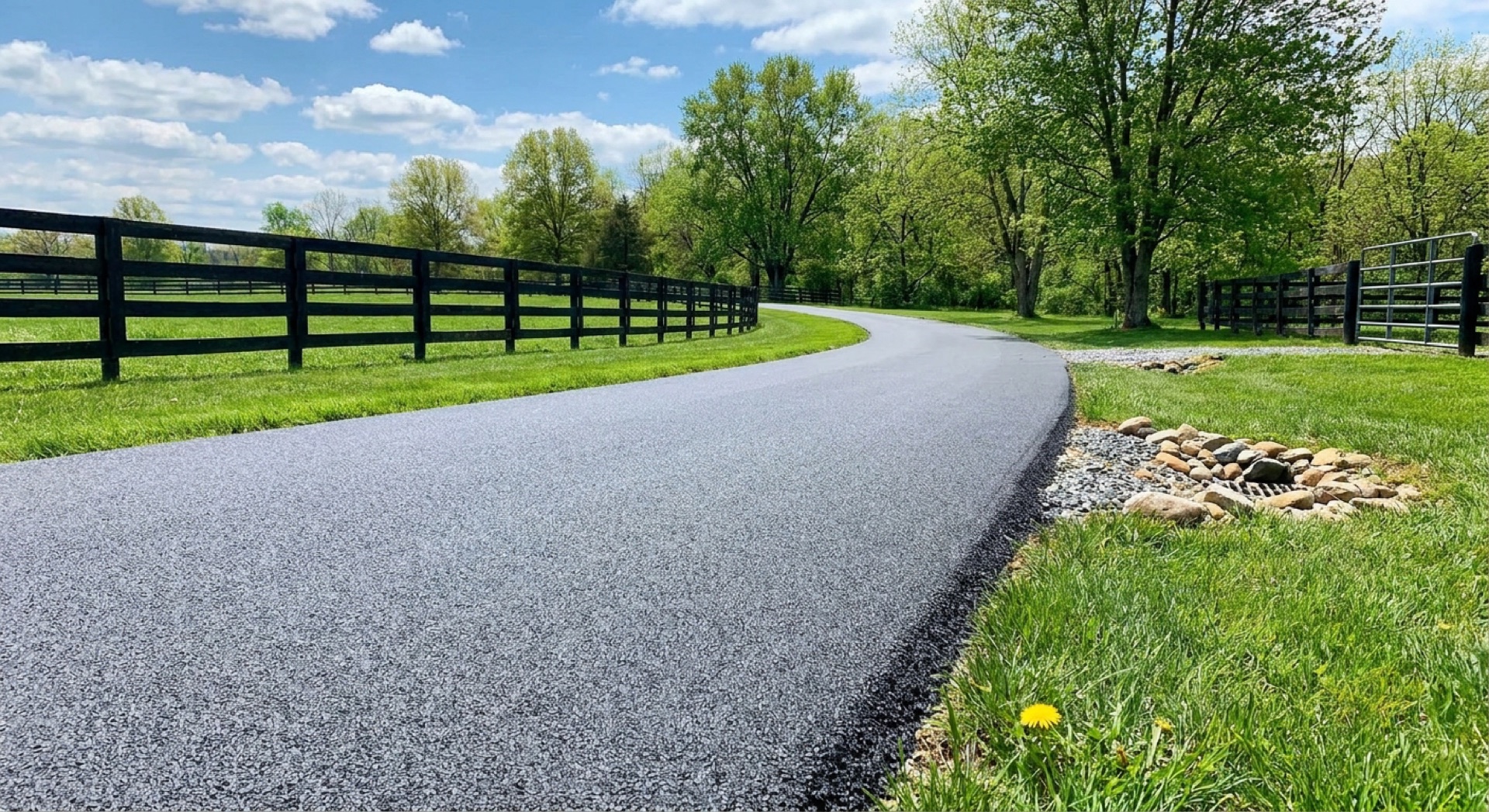
Private road paving rural Loudoun County VA
500+
Projects Completed
15
Years in Loudoun County
5.0
Star Google Rating
20+
Cities Served

Private Road Paving Services in Loudoun County

Gravel-to-Asphalt Conversion

The most common private road paving project in rural Loudoun County is converting an existing gravel road or driveway to asphalt. The process: grade the existing gravel to establish proper crown (1/4"–3/8" per foot from center) and drainage swales, add VDOT 21B aggregate base material where existing stone is thin, compact to 95% density, and pave SM-9.5A Superpave surface course. Minimum paving width: 10 feet for one-lane rural access; 14 feet for two-way vehicle passage.

Shared Access Road Construction

Shared driveways and access roads serving multiple parcels in rural Loudoun are common — particularly on properties divided from larger farms. Shared access road construction involves designing the road width and structural section for the anticipated vehicle count and load, establishing recorded easements for maintenance responsibilities, and constructing the road to a standard that all parties can maintain. We work with property owners and attorneys on shared access projects to ensure the physical improvements match the legal easement language.

Estate Driveway Paving

Long estate driveways in Loudoun County's rural communities — particularly properties in Middleburg, Waterford, and the Route 9 and Route 7 corridors west of Purcellville — often run 400–1,500 feet from the public road to the home. These driveways require careful drainage design to handle runoff without washout, proper crown grading to drain to the sides, and culvert coordination at any low points. We design estate driveways for both function and appearance — a long smooth asphalt approach frames the property beautifully.

Resurfacing Deteriorated Private Roads

Many private roads in rural Loudoun were paved 20–30 years ago and have never been maintained. These roads are typically still structurally sound at the base level but have severe surface cracking, edge raveling, and potholing. Mill-and-overlay is the most cost-effective rehabilitation: cold mill the existing surface to 1.5"–2", make any base repairs needed at pothole locations, and overlay with new SM-9.5A.

This restores 15–20 years of surface life at roughly half the cost of full reconstruction.

Signs Your Loudoun County Private Road Needs Attention

Private roads in western and rural Loudoun County are often the last paving on a property to receive attention — and the first to fail badly. These signs indicate when action is needed.

Developing Potholes in the Road Surface

Potholes on a private road typically start at the edges and low points — areas where drainage concentrates water against the base. Once potholes develop, each rain event carries more water into the base through the open holes. Private road potholes grow significantly faster than driveway potholes because the combination of higher traffic speeds, vehicle loads, and less frequent maintenance creates faster edge-raveling cycles.

Catching private road potholes at 3–5 individual locations usually means mill-and-overlay is still the right scope — wait until they multiply and full reconstruction becomes necessary.

Washout Sections After Heavy Rain

A private road surface that washes out or erodes after each significant rain event has a drainage design problem — water is running along the road rather than draining off it. This is caused by inadequate crown slope, blocked culverts, or insufficient ditch grading that allows water to sheet across and undercut the asphalt. The correct fix is drainage correction first (culvert replacement or clearing, ditch regrading, crown adjustment) followed by paving — paving over a drainage problem without fixing the drainage just creates the same washout in the new surface.

Edge Crumbling and Perimeter Loss

Private roads in rural Loudoun often lack curb and gutter, with asphalt edges abutting gravel shoulders or grass. When lateral support erodes, edge crumbling begins: chunks of asphalt separate from the road perimeter, narrowing the effective driving surface. On a 12-foot road, losing 6 inches on each side in a season means the road is effectively a 10-foot road within 2–3 years.

Edge crumbling that is caught early can be sealed and stabilized; advanced edge loss requires a new asphalt edge section and the original surface width cannot be recovered without adding new material.

Gravel Road Requiring Annual Replenishment

A gravel private road that requires $1,000–$3,000 in annual stone replenishment and grading has already reached the cost break-even point where paving pays for itself within 7–10 years on maintenance cost alone. Gravel roads with heavy clay subsoil — common in Loudoun's Piedmont geography — lose stone fastest because clay is a poor base for gravel stability. If you're having gravel hauled in and graded every 1–2 years, the cumulative cost over a decade exceeds the cost of a proper asphalt installation that requires no annual material cost.

Age 20+ Years with No Resurfacing

Private roads paved in the 1990s and early 2000s across western and central Loudoun County are now at or past their first resurfacing window. Rural private roads without sealcoating programs age faster than residential driveways because they receive less frequent maintenance and are exposed to more water infiltration from adjacent drainage swales. At 20+ years without resurfacing, most private road surfaces have significant cracking and surface oxidation — but the base, if the original construction was done correctly, is often still serviceable and mill-and-overlay extends the road life for another 15–20 years.

Emergency Vehicle Access Concerns

Loudoun County Fire and Rescue requires a minimum 20-foot-wide, all-weather surface capable of supporting apparatus up to 75,000 lbs for any private road serving as the only access route to a residence. Private roads that have deteriorated to the point where full-size fire apparatus would bottom out on potholes or risk getting stuck in edge-failed sections may be flagged during a code inspection or insurance renewal. Maintaining a structurally sound private road surface is not only a property value matter — it may be a condition of homeowner's insurance coverage in rural Loudoun.

The Private Road Paving Process

1

On-Site Road Survey

We travel to the property, walk the full road length, measure width and length, assess the existing surface and base condition, identify drainage issues (low points, inadequate crown, blocked culverts), and determine scope. For gravel conversions, we probe the existing stone depth to confirm whether additional base material is needed. Free estimates — we travel throughout rural Loudoun including Purcellville, Middleburg, and the western towns.

Survey appointment scheduled within 3–5 business days.

2

Base & Drainage Preparation

For gravel conversions: existing stone graded to proper crown slope (1/4"–3/8" per foot), drainage swales shaped, culverts cleared or replaced. VDOT 21B base material added where existing stone is less than 6" compacted depth. All base material compacted to 95% standard Proctor density with vibratory drum roller.

Base preparation is the most critical phase — it's what separates a private road that lasts 20 years from one that starts failing in 5. Takes 1–3 days depending on road length.

3

SS-1h Tack Coat & Paving

SS-1h tack coat applied at 0.08–0.15 gal/sq yd to the prepared base surface. SM-9.5A Superpave hot-mix is placed by an asphalt paver at 2"–3" compacted depth for standard private road construction (2" for driveways, 3" for roads carrying heavy vehicles). Compacted with a vibratory steel-drum roller to achieve 92%+ of theoretical maximum density.

Typical private road paving production: 800–1,500 linear feet per day depending on road width and curve radius.

4

Edge Finishing & Road Open

Asphalt edges are feathered and compacted to prevent raveling where the pavement meets the gravel shoulder. Culvert headwalls and aprons are graded flush with the finished road surface. Road is open to passenger vehicles within 2 hours and heavy vehicles within 24 hours in warm conditions.

We do a final walkthrough to identify any low spots or drainage concerns before leaving the site. Sealcoating can be scheduled 12 months after paving for maximum life protection.

Private Road Paving Cost Guide — Loudoun County

ScopeTypical CostNotes
Short rural driveway (up to 200 LF × 10'–12')$5,000–$15,000Gravel-to-asphalt; includes base prep
Medium private road (200–500 LF × 12'–14')$15,000–$40,000Includes drainage, culverts, edge finish
Long estate driveway (500–1,500 LF)$40,000–$120,000+Varies significantly with drainage requirements
Mill-and-overlay on existing private road$3.00–$5.00/sq ftBest value for roads with sound existing base
Additional base material (VDOT 21B)$25–$45/ton deliveredRequired when existing base is under 6"
Pipe culvert installation (12"–18")$800–$2,500 per culvertCorrugated metal or HDPE pipe

Asphalt vs. Gravel for a Private Road — Which Is Right?

Asphalt — Right When

  • Daily use — gravel requires $500–$2,000/year in replenishment and grading
  • Property value: asphalt improves curb appeal vs. gravel
  • Lower maintenance cost over 20 years (sealcoat vs. annual grading)
  • No dust, no stone thrown by tires, no tracking into garage
  • Multiple vehicles / higher traffic volume

Gravel — Right When

  • Road is longer than ¼ mile with very low use — cost vs. use doesn't favor asphalt
  • Agricultural use — farm equipment may damage asphalt edges
  • Natural aesthetic preference — some rural historic properties prefer gravel
  • Budget doesn't allow asphalt now — gravel as interim surface
  • Road is temporary — property use may change

Private Road Paving in Rural Loudoun County — What Makes This Market Different

Rural Loudoun County west of Leesburg contains one of the highest concentrations of private road paving projects in the Northern Virginia region. The geography explains it: large-lot zoning in Purcellville, Hamilton, Round Hill, Lovettsville, and Waterford means that properties of 5–100+ acres are common, and those properties often have lane runs of 400–1,500 feet from the public road to the residence or farm structures. Many of these properties were developed in the 1970s–1990s and established long gravel or dirt access lanes as interim surfaces — a substantial portion of which have never been paved.

The soils underlying western Loudoun are predominantly Piedmont clay and weathered granite residuum, which drain slowly and become unstable when wet. Gravel roads on Piedmont clay lose aggregate faster than roads on better-draining soils, which is why private road replacement costs through annual gravel replenishment compound quickly and push the ROI calculation toward permanent asphalt paving within 7–10 years for roads with regular vehicle use.

The eastern Loudoun private road market has different characteristics — primarily shared access roads and HOA-managed internal streets in master-planned communities where the public road dedication was delayed or the road serves fewer than 10 lots. These roads were typically built to a higher standard than rural gravel lanes (some with curb and gutter, proper structural sections), but many have aged without the maintenance program that a public VDOT road would receive. Mill-and-overlay is almost always the right scope for eastern Loudoun private roads with sound base structure.

Western Loudoun rural roads more often require full-depth construction from grade up — clearing and grubbing, subgrade preparation, 6"–8" VDOT 21B aggregate base, drainage swale shaping, and SM-9.5A surface paving. Leesburg Asphalt serves both markets and carries the equipment complement — compact pavers for tight rural access, full-size equipment for larger road builds — to handle the full scope.

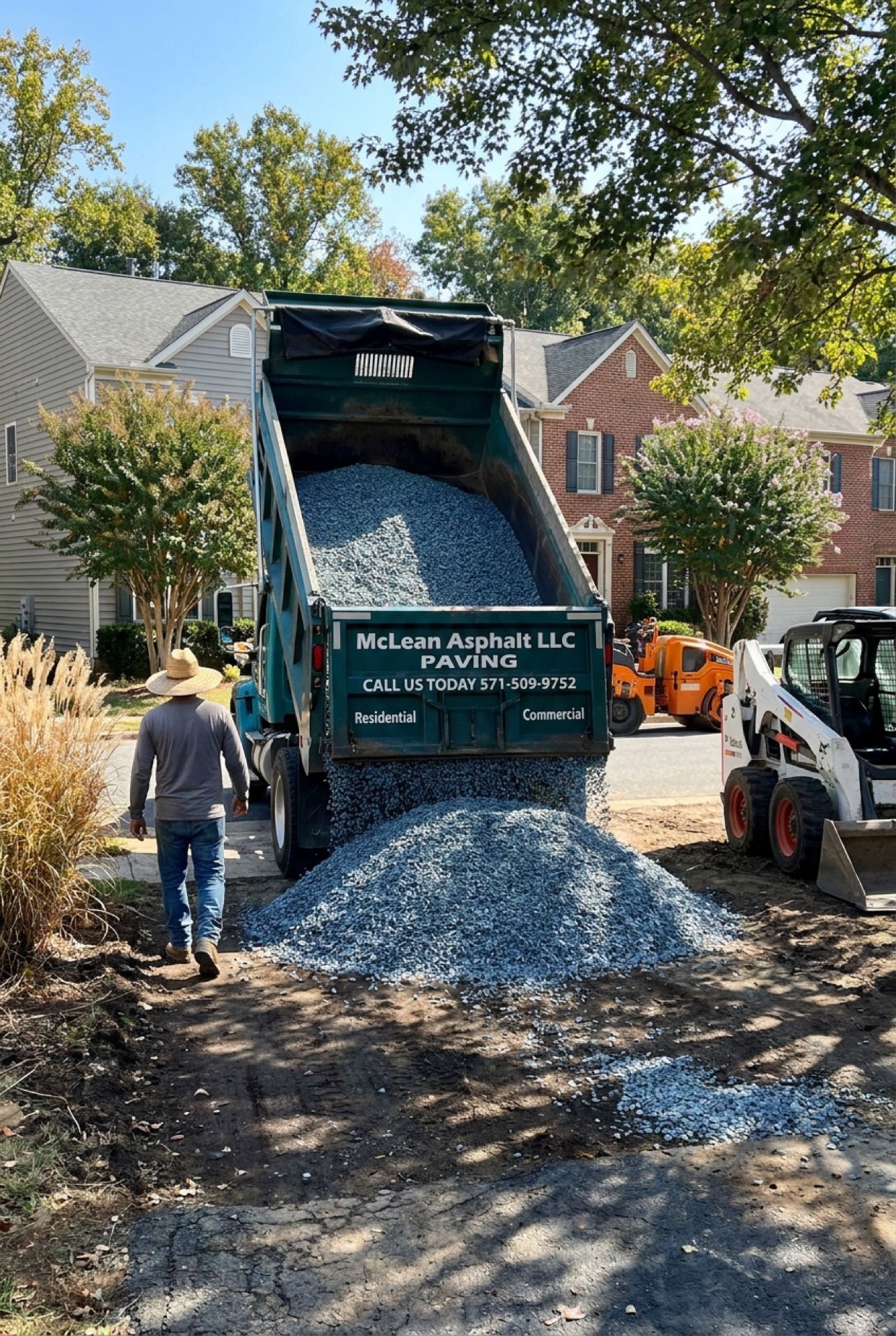
Material delivery for private road paving rural Loudoun County VA

Private Road Paving FAQ — Loudoun County

How much does private road paving cost in Loudoun County, VA?

Private road paving in Loudoun County runs approximately $8–$18 per linear foot for a 12-foot-wide road, or $3.00–$6.00 per square foot, including base preparation and paving. Short rural driveways (up to 200 feet) typically cost $5,000–$15,000. Medium private roads (200–500 feet) cost $15,000–$40,000.

Long estate driveways (500 feet+) cost $40,000–$120,000+ depending on drainage requirements and road width. Additional base material and culvert work add to these figures. Free on-site estimates for all rural Loudoun locations.

Do private roads in Loudoun County require permits?

In Loudoun County, private road paving typically doesn't require a standard building permit for replacing like-for-like surface. However, projects that involve grading, earthwork over 150 cubic yards, or drainage work within a stream buffer (RPA — Resource Protection Area) may require a land disturbance permit or RPA buffer determination. New road construction (not resurfacing) on rural properties may also require a Loudoun County entrance permit where the private road meets a public road.

We assess permit requirements at the free estimate visit.

How wide should a private road be?
Minimum private road widths in Loudoun County: 10 feet for a one-lane road with occasional two-way use and passing areas, 14 feet for standard two-way single-lane traffic, 18–20 feet for two full lanes of two-way traffic or fire apparatus access. Loudoun County fire code requires 20-foot-wide private roads for emergency vehicle access to homes with longer driveways. If your road serves multiple parcels and is recorded as a shared access easement, the required width is often specified in the easement document — we verify this before quoting.
Can you pave a private road in winter?
Hot-mix asphalt paving requires ground temperatures above 40°F and air temperatures above 35°F and rising. In Loudoun County, weather permitting, we can pave into late November and resume in early March. Most private road base preparation work (grading, base material placement, compaction) can be done in cooler weather when paving is not yet possible — many projects benefit from phasing base work in fall and paving in spring when the ground has settled and we're past the freeze-thaw risk window for new base compaction.
What asphalt mix is best for a rural private road in Virginia?

SM-9.5A Superpave surface course with PG 64S-22 binder is the standard specification for private road paving in Loudoun County — the same mix used on VDOT secondary roads. SM-9.5A has a 9.5mm nominal maximum aggregate size, which provides good workability around curves and at road edges while delivering adequate structural depth per inch. For private roads carrying heavy vehicles (farm equipment, horse trailers, delivery trucks), we use 3" compacted depth of SM-9.5A over 6"–8" VDOT 21B aggregate base.

For estate driveways with passenger vehicles only, 2" compacted SM-9.5A over a well-graded existing gravel base is sufficient and cost-effective. We assess the anticipated vehicle loads at the estimate visit to determine the right structural section.

How long will a properly paved private road last?

A private road built to VDOT specification — VDOT 21B aggregate base compacted to 95% density, SM-9.5A surface course at 2"–3" compacted depth — will last 20–25 years with basic maintenance. The maintenance program is simpler than for a residential driveway: crack sealing when cracks develop (typically years 7–12), and a sealcoating application at 18–24 months after paving to protect the surface. Private roads that receive sealcoating at the right time regularly achieve 25+ year surface life.

The biggest risk factor is drainage: a private road with proper crown slope and clear drainage swales will outlast one with drainage problems by 5–10 years. We address drainage design at the time of construction to protect the life of the investment.

Who is responsible for maintaining a shared private road in Loudoun County?

In Virginia, shared private roads are governed by the recorded easement document. Maintenance responsibility is divided among the property owners who share access rights, typically in proportion to road usage or lot count, as specified in the easement. The Virginia Code Section 55.1-2821 provides for division of maintenance costs among easement holders when a recorded agreement is in place.

In practice, shared road maintenance disputes are common — especially when one property owner uses the road more heavily than others. Leesburg Asphalt recommends that shared-road paving projects be completed with a cost-sharing agreement in place before the work begins; we can provide itemized written estimates that divide cost proportionally to facilitate that agreement.

Ready to Pave Your Private Road?

Leesburg Asphalt travels throughout rural Loudoun County — Purcellville, Middleburg, Hamilton, Round Hill, Lovettsville, and Waterford — for free on-site estimates. No mileage charge, no minimum distance. Call today.

(703) 382-5769 — Free On-Site Estimate
(703) 382-5769