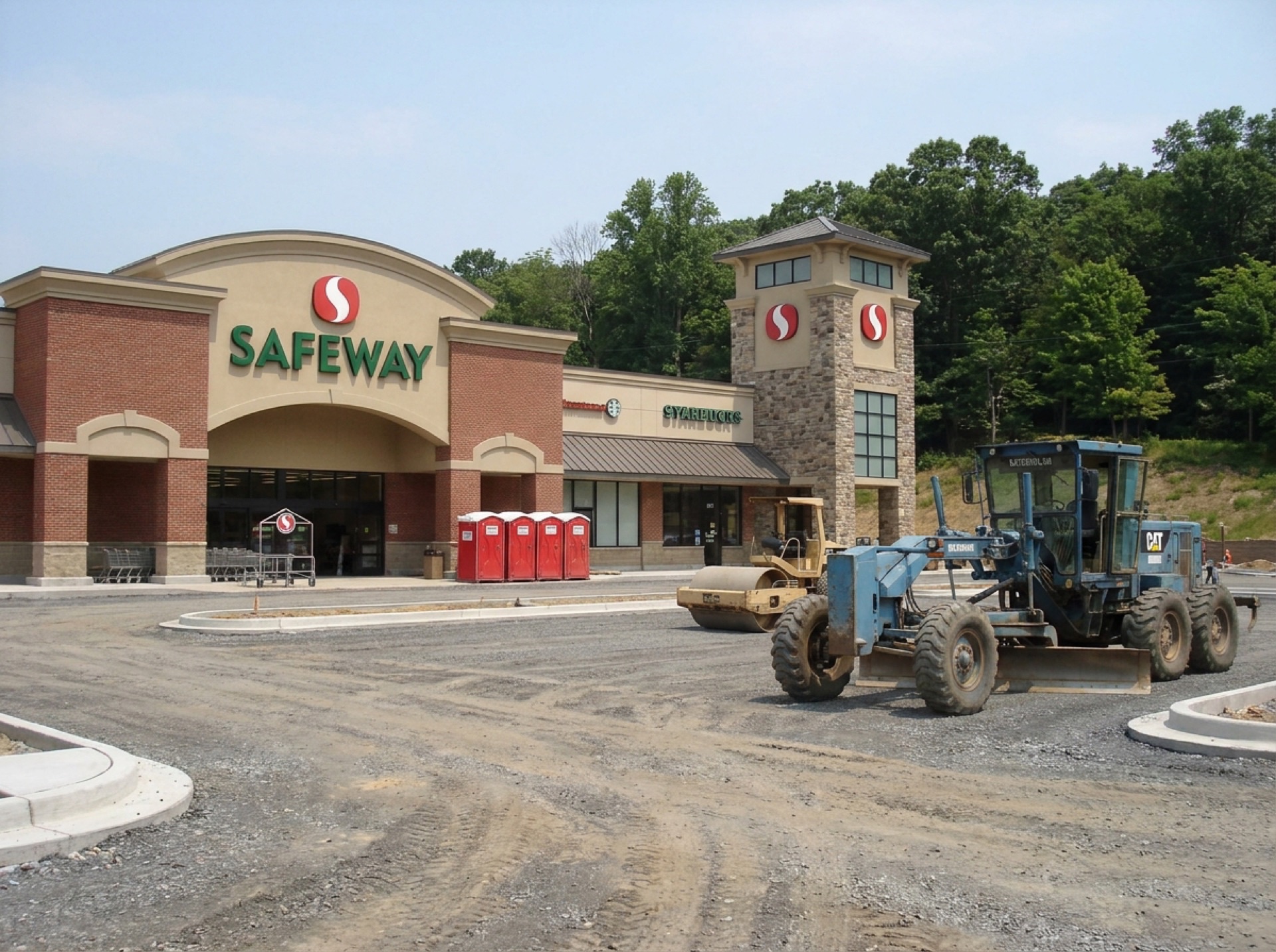
Commercial Paving in Leesburg, VA

Parking Lots · Access Roads · Loading Docks · ADA Compliance

Leesburg Asphalt provides commercial asphalt paving for businesses, property management companies, HOAs, churches, medical facilities, and industrial properties throughout Loudoun County, VA. We build and rehabilitate commercial asphalt surfaces to VDOT specification using IM-19.0A intermediate course and SM-9.5A Superpave surface course with PG 64S-22 binder — the same spec used on Virginia public roads, not a watered-down residential mix.

Commercial paving in Leesburg runs $2.50–$10.00+ per square foot depending on scope — overlay only, mill-and-overlay, or full-depth new construction. We coordinate Loudoun County commercial permits, handle phased paving to keep your business operating, and include ADA-compliant layout in every parking lot project. Free written estimates within 24–48 hours.

(703) 382-5769

Free Commercial Paving Estimate

Why Leesburg Asphalt is the Best at Commercial Paving

Leesburg Asphalt paves commercial properties throughout Loudoun County, VA to VDOT specification — IM-19.0A intermediate + SM-9.5A surface course, PG 64S-22 binder, with permit coordination and ADA compliance included.

  • VDOT-spec materials: IM-19.0A intermediate course + SM-9.5A Superpave surface with PG 64S-22 performance-graded binder
  • Commercial-grade structural design: 8"–12" VDOT 21B aggregate base, intermediate course, surface course for full-depth construction
  • Loudoun County commercial paving permit coordination — we handle the paperwork at loudoun.gov
  • Phased paving approach for occupied properties — keeps 50%+ of lot accessible throughout the project
  • ADA 2010-compliant accessible stall layout included with every parking lot project
  • MISS UTILITY coordination (811) completed before any excavation — required by Virginia law
  • Written scope and fixed-price contract — no scope creep, no surprise change orders
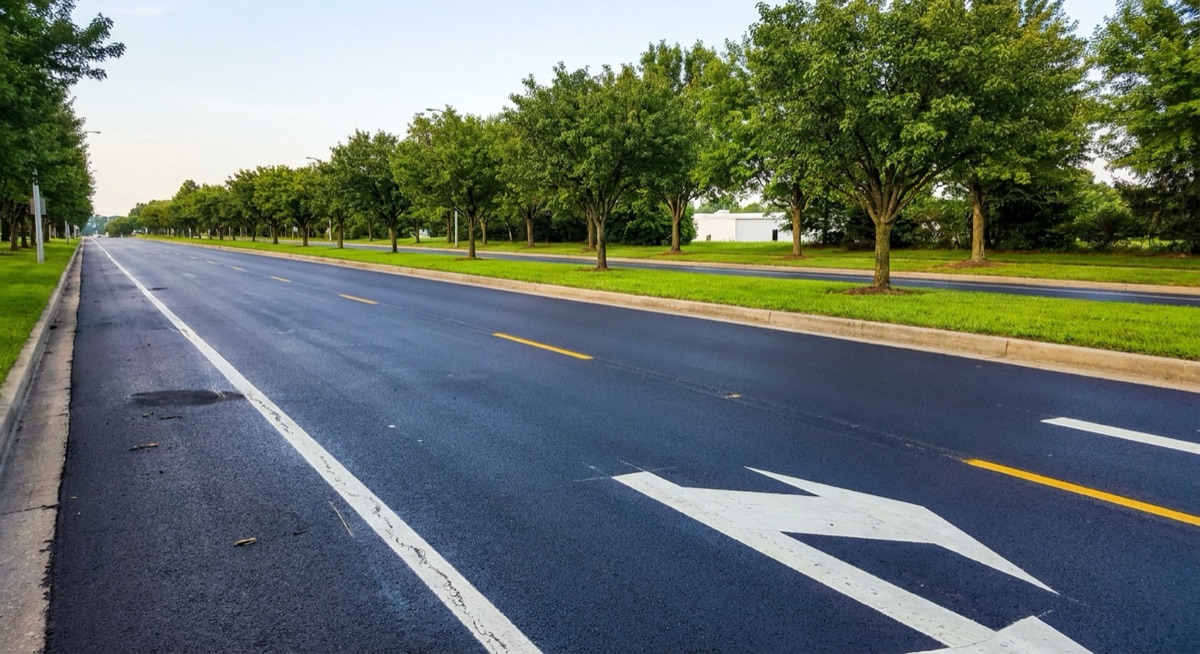
Commercial asphalt paving Leesburg Loudoun County VA
500+
Projects Completed
15
Years in Loudoun County
5.0
Star Google Rating
20+
Cities Served

Commercial Paving Services We Provide

Retail & Office Parking Lots

Parking lots for retail centers, office parks, medical facilities, and mixed-use properties are our core commercial work in Loudoun County. New construction, mill-and-overlay, and full-depth reclamation. ADA-compliant stall layout, fire lane markings, and re-striping included.

Phased paving keeps the lot operational throughout. We work with property managers, commercial REITs, and small business owners directly.

Access Roads & Drive Aisles

Commercial access roads, drive aisles, and fire access lanes require heavier structural design than residential driveways — particularly for sites with regular truck deliveries, dumpster service, or fire apparatus access. We engineer access road cross-sections based on axle load requirements, using BM-25.0A base course where standard IM-19.0A is insufficient for heavy vehicle loading. Sight-line grading and proper drainage design are included in the assessment.

Loading Docks & Service Areas

Loading dock aprons and service yard areas take the most abuse of any commercial asphalt surface — concentrated static loads from parked trailers, turning stress from bobtail trucks, and repeated delivery vehicle cycling. These areas require a minimum 4" of SM-9.5A over 10"–12" of compacted aggregate base, with BM-25.0A substituted for IM-19.0A in the base course where loads exceed 80,000 lbs GVW. We assess loading dock specs before quoting.

HOA Common Area Paving

Loudoun County HOAs — particularly in communities like South Riding, Broadlands, Lansdowne, and Brambleton — have shared asphalt surfaces including internal roads, visitor parking areas, and amenity center lots. HOA paving projects require coordination with property managers and boards, and often need to meet community HOA covenants regarding surface type and appearance. We provide HOA board-ready written estimates and can present at board meetings for approval.

Signs Your Leesburg Commercial Property Needs Paving Service

Commercial property owners often defer paving maintenance until the lot is visibly failing — by which point the repair scope has escalated from overlay to reconstruction. These are the signs that maintenance is overdue.

Customer or Employee Complaints

When customers or employees are verbally complaining about the parking lot, the deterioration is past the visible-to-professionals stage and into the visible-to-everyone stage. Online reviews mentioning pot holes, rough pavement, or poor lot condition affect customer perception and your property's competitive position among nearby businesses. Commercial paving deferred until it draws complaints has typically passed the overlay-only window and requires mill-and-overlay or partial reconstruction.

Trip-and-Fall Liability Exposure

Potholes, raised pavement edges, and significant surface deterioration create documented trip hazard liability for commercial property owners. Virginia courts have consistently held that property owners are liable for known pavement hazards. The discovery phase of any personal injury lawsuit will ask whether you had knowledge of the condition — a history of deferred maintenance repair requests is exactly the documentation that establishes knowledge.

Commercial paving repair or prevention eliminates the exposure at a cost far below a single claim settlement.

ADA Accessibility Deficiencies

Surface deterioration in accessible stall and access aisle areas can create ADA cross-slope violations — cracked, uneven surfaces that exceed the 2% maximum cross-slope for accessible spaces even if the original construction was compliant. When a lot undergoes substantial improvement (which includes mill-and-overlay in many jurisdictions), ADA compliance must be brought up to current standards. Leesburg Asphalt audits accessible features and includes correction costs in every commercial paving proposal to protect property owners from DOJ complaints.

Faded Striping + Surface Oxidation

When parking lot striping has faded to near-invisible and the surface has turned gray-brown from UV oxidation, both sealcoating and re-striping are overdue — likely by 2–3 years. Faded striping in a commercial lot creates traffic flow confusion, makes accessible stall markings legally non-compliant, and undermines the professional appearance of the property. Applying sealcoating followed by fresh thermoplastic or paint striping is one of the highest-ROI maintenance investments for commercial properties.

Drainage Problems (Standing Water)

Puddles that remain 30–60 minutes after rain in areas that should drain are an early indicator of grade problems — either settlement has created low points or inadequate cross-slope. Standing water in a parking lot is not just a nuisance; it's a base failure accelerant. It also creates slip-and-fall liability in winter when it freezes.

Drainage issues caught early can be addressed during a mill-and-overlay with minor grade corrections; left until base failure is widespread, they require full excavation and reconstruction.

3+ Years Without Sealcoating

Commercial lots that haven't been sealcoated in 3 or more years are actively losing surface protection — the sealer film has worn through in high-traffic areas, leaving bare asphalt exposed to UV oxidation, water infiltration, and fuel spill penetration. Sealcoating a commercial lot every 3–4 years costs $0.10–$0.20 per square foot — roughly $1,000–$2,000 for a 10,000 sq ft lot. At that price point, the ROI vs. deferred resurfacing is undeniable: one sealcoat cycle versus $25,000+ in mill-and-overlay in 3–5 fewer years.

The Commercial Paving Process

1

Site Assessment & Scope

On-site assessment includes measuring total paving area, evaluating existing pavement condition (new vs. rehabilitation), assessing drainage patterns, identifying utility conflicts, and determining appropriate scope — overlay, mill-and-overlay, base repair + overlay, or full reconstruction. Estimate delivered in writing within 24–48 hours. We also identify any ADA deficiencies in the existing layout and include correction cost in the estimate.

2

Permit Coordination

Commercial paving in Loudoun County typically requires a grading and land disturbance permit from the Loudoun County Department of Building and Development (loudoun.gov). We prepare and submit the permit application, coordinate with the county reviewer, and track approval. Permit lead time is typically 5–10 business days for standard commercial paving.

MISS UTILITY 811 locate tickets are pulled minimum 3 business days before any excavation begins.

3

Phased Paving Execution

For occupied properties, we develop a phasing plan that divides the lot into sections and paves them sequentially — keeping at least one usable access aisle and customer parking area available throughout. Section transitions typically take 1–2 days per phase for a 20,000–50,000 sq ft lot. Traffic control cones, temporary signage, and flaggers are deployed as needed for each phase.

Total project duration: 2–5 days for most commercial lots.

4

Striping, Signage & Final Inspection

After 24–48 hours cure, parking lot striping is applied per the ADA-compliant layout plan — stall lines, accessible stalls and access aisles, ISA symbols, fire lane markings, directional arrows. Accessible stall signs are installed at the correct height and location per Virginia Building Code. Final walkthrough with property manager or owner documents stall count, accessible stall locations, and lot condition at handoff.

Commercial Paving Cost Guide — Leesburg & Loudoun County

ScopeCost RangeNotes
Overlay only (SM-9.5A surface, good base)$2.50–$4.00/sq ftMost cost-effective rehabilitation option
Mill-and-overlay (1.5"–2" mill + SM-9.5A)$3.50–$6.00/sq ftGrade correction included in milling pass
Full-depth new construction$5.00–$10.00+/sq ftSubgrade, 21B base, IM-19.0A, SM-9.5A
Loading dock / heavy vehicle area$8.00–$14.00/sq ftHeavier base section, BM-25.0A intermediate
Permit (Loudoun County commercial)$250–$1,500County fee; we handle submission
Striping (included in most paving quotes)$500–$3,500ADA stalls, fire lanes, directional arrows

Commercial vs. Residential Asphalt — Why It Matters

Commercial Specification

  • IM-19.0A intermediate course — larger aggregate, more structural depth per inch
  • SM-9.5A Superpave surface — tested to VDOT spec for durability and skid resistance
  • PG 64S-22 binder — tested for high-temp rutting resistance and low-temp crack resistance
  • 8"–12" VDOT 21B aggregate base — handles vehicle and truck loads without settling
  • 92–93% TMD compaction requirement — verified by nuclear density gauge

What to Avoid

  • SM-9.5A only (no intermediate course) — thinner effective structural depth
  • Plant-screened recycled mix without VDOT spec certification
  • Aggregate base less than 6" under a commercial lot
  • No density testing — no confirmation material is compacted properly
  • No ADA audit — liability exposure from non-compliant accessible stalls

Commercial Paving in the Loudoun County Market

Loudoun County's commercial paving market is concentrated along two major corridors: the Route 7 (Harry Byrd Highway) corridor from Leesburg east through Ashburn and Sterling, and the Route 28 (Sully Road) tech corridor running from Chantilly north through Dulles. Both corridors experienced rapid commercial build-out between 1995 and 2015 — a wave of strip centers, office parks, medical campuses, and industrial flex space that is now entering its first major rehabilitation cycle. Parking lots built in that era were constructed to VDOT specification and represent sound structural investments, but surface maintenance has been inconsistent across the portfolio.

The result is a large market of lots that are structurally sound but have overtaxed surface courses — ideal candidates for mill-and-overlay rather than full reconstruction, which preserves the substantial original investment in base preparation while restoring 15–20 years of surface life.

The western Loudoun commercial market is different in character — smaller retail nodes in downtown Leesburg, Purcellville, and Middleburg, plus HOA-managed community facilities in master-planned developments like South Riding, Broadlands, Lansdowne, and Brambleton. HOA commercial paving (community centers, visitor parking, internal roads) requires coordination with property management companies and HOA boards, and often involves phased budget approval that affects project timing. Leesburg Asphalt provides HOA board-ready written estimates that break scope into prioritized phases — enabling boards to approve urgent work in the current budget cycle while deferring non-critical improvements to future years.

We understand that commercial decisions in Loudoun County operate on community schedules, not contractor schedules.

Commercial asphalt paving Loudoun County Route 7 corridor

Commercial Paving FAQ — Leesburg & Loudoun County

How much does commercial paving cost in Leesburg, VA?

Commercial asphalt paving in Leesburg runs $2.50–$4.00 per square foot for overlay only on a sound base, $3.50–$6.00 per square foot for mill-and-overlay, and $5.00–$10.00+ per square foot for full-depth new construction. A 10,000 sq ft parking lot in good base condition costs approximately $25,000–$40,000 for resurfacing. Heavy vehicle areas like loading docks require a heavier structural section and run $8.00–$14.00 per square foot.

Cost per square foot decreases as lot size increases due to equipment efficiency.

Do commercial paving projects in Loudoun County require permits?

Most commercial paving projects in Loudoun County require permits. A grading and land disturbance permit is required for work that disturbs more than 2,500 square feet of land or creates more than 150 cubic yards of earthwork. Projects affecting impervious surface area may also require a site plan amendment if the new impervious area exceeds limits in the existing site plan.

Leesburg Asphalt handles all permit applications at loudoun.gov on your behalf — permit cost ranges from $250 to $1,500 depending on scope and is included in our estimate.

Can you pave a commercial lot without closing it completely?

Yes — phased paving is standard practice for occupied commercial properties. We divide the lot into sections, pave each section sequentially, and keep the remaining sections accessible throughout the project. Most properties can maintain 40–60% of their parking during paving.

The phases are coordinated with your business schedule — many clients prefer early morning start times and we adjust phasing around peak business hours. A 20,000 sq ft lot with phased paving typically takes 3–4 days versus 1–2 days for a complete closure.

How long does a commercial asphalt lot last?

A properly constructed commercial parking lot built to VDOT specification — IM-19.0A intermediate + SM-9.5A surface, 8"+ compacted aggregate base — lasts 20–30 years with proper maintenance. The maintenance program: sealcoating every 3–4 years, crack sealing annually as needed, and pothole repair as they appear. Without maintenance, surface life drops to 10–15 years.

The total cost of 8–10 sealcoating cycles over 30 years is roughly equivalent to one reconstruction — maintenance always wins on life-cycle cost.

What asphalt mix specification is used for commercial parking lots in Virginia?

Commercial parking lots in Virginia are typically built to VDOT specification using IM-19.0A intermediate course (larger aggregate, greater structural depth per inch) and SM-9.5A Superpave surface course with PG 64S-22 performance-graded binder. The PG 64S-22 designation means the binder is tested to remain stable at 64°C (high-temperature rutting resistance) and flexible at -22°C (low-temperature crack resistance) — the correct specification for Loudoun County's climate. Residential driveways sometimes use SM-9.5A only without an intermediate course, which provides less structural capacity for vehicle loads above 80,000 lbs GVW.

Loading dock areas require BM-25.0A base course for maximum structural support.

Does repaving a commercial lot require ADA accessibility upgrades?

Under the ADA, a "path of travel" requirement applies when a business undertakes a renovation or alteration — which the ADA and DOJ consider to include mill-and-overlay of a parking lot. The rule requires that improvements to accessible features (accessible stalls, access aisles, accessible route to the building entrance) be included up to 20% of the total alteration cost. Practically, this means a complete lot repaving almost always triggers a requirement to bring accessible stalls up to current 2010 ADA Standards for Accessible Design — van-accessible stall size, access aisle width, cross-slope not exceeding 2%, and ISA signage at the correct height.

Leesburg Asphalt audits existing accessible features and includes ADA correction costs in every commercial repaving estimate to ensure property owners understand the full compliance requirement before the contract is signed.

How long do vehicles need to stay off a newly paved commercial lot?

Freshly paved asphalt reaches enough structural stability for passenger vehicles within 2–4 hours in summer (air temperature 75°F+) and 4–8 hours in cooler weather (50–65°F). For commercial lots where vehicle traffic cannot be completely controlled, we recommend a 24-hour closure for the paved area when possible — particularly in warm weather when the surface is still slightly pliable and can be marked by vehicle turning movements and jack stands. Heavy vehicles (delivery trucks, dumpsters, bucket trucks) should wait a minimum of 72 hours and ideally 5–7 days before driving or parking on new asphalt.

Full cure — when the asphalt reaches its design density and the binder sets completely — takes 30–90 days depending on temperature conditions.

Commercial Paving Throughout Loudoun County

Leesburg Asphalt is Loudoun County's locally-owned commercial paving contractor — VDOT-spec materials, permit coordination, ADA compliance, and phased paving to keep your property operational. Free written estimates within 24–48 hours.

(703) 382-5769 — Free Commercial Estimate
(703) 382-5769