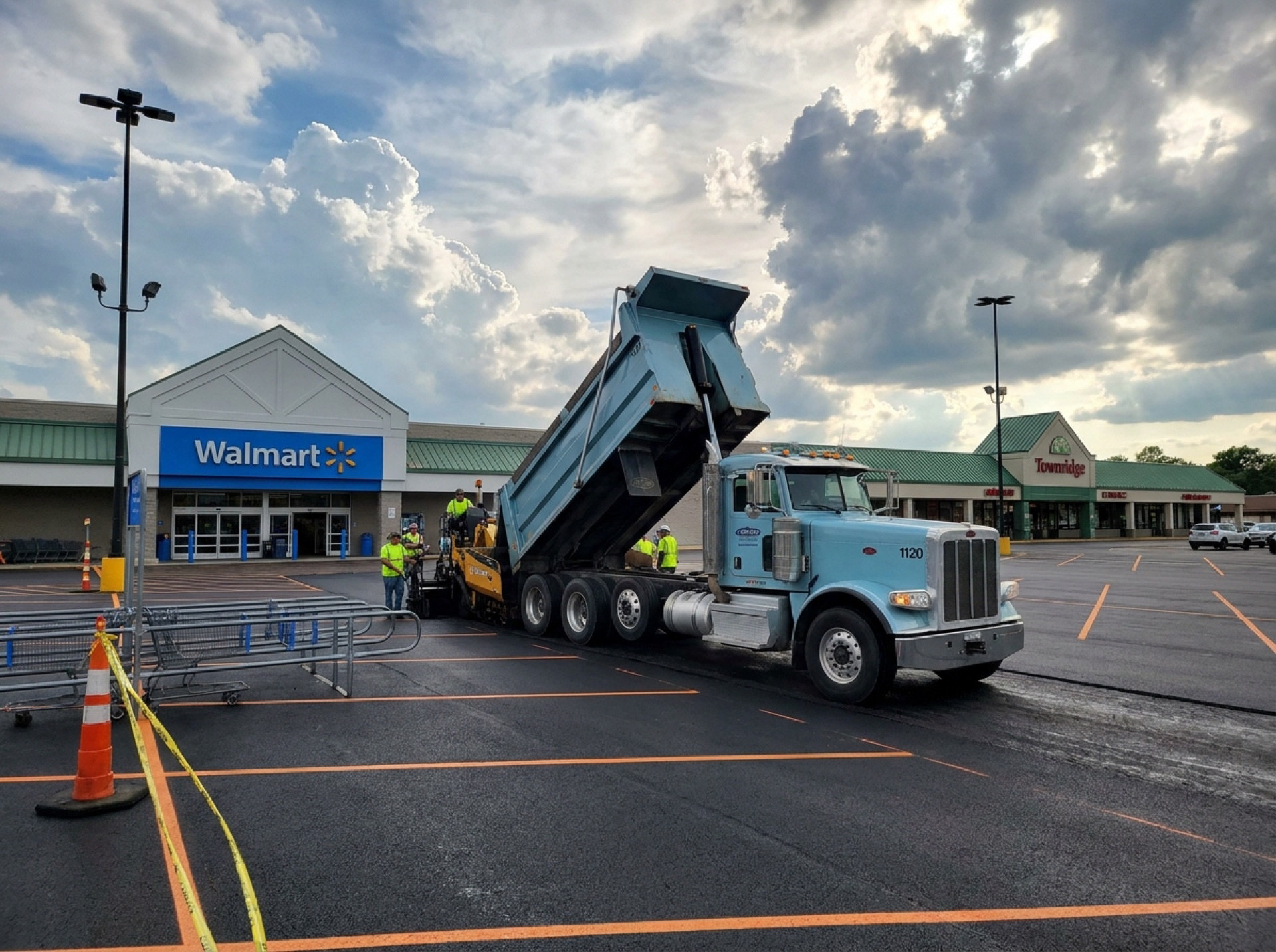
Leesburg Asphalt installs and rehabilitates asphalt parking lots for businesses, HOAs, churches, and property managers throughout Loudoun County, VA. We build new lots from sub-grade to finished surface using IM-19.0A intermediate course and SM-9.5A Superpave surface course, and we rehabilitate deteriorated lots with mill-and-overlay, full-depth reclamation, or targeted base repair — depending on which approach delivers the best long-term value for your property.
Parking lot paving cost in Leesburg typically runs $2.50–$6.00 per square foot for resurfacing and $5.00–$10.00+ per square foot for new construction, depending on lot size, drainage requirements, and existing base conditions. We coordinate Loudoun County commercial paving permits and Virginia ADA compliance. Free estimates.
Leesburg Asphalt paves commercial parking lots throughout Loudoun County, VA using VDOT-spec materials, proper drainage design, and Virginia ADA-compliant layout — no shortcuts on spec, no sub-par mixes.
Full-depth construction from subgrade up. We excavate and shape to finished grade, compact the subgrade to 95% of standard Proctor density, place 8"–12" of VDOT 21B compacted aggregate base, apply SS-1h tack coat at 0.08–0.15 gal/sq yd, and pave IM-19.0A intermediate course followed by 1.5"–2" of SM-9.5A surface course. Suitable for retail, medical, office, church, and multi-family property lots.
The most cost-effective rehabilitation for lots with surface distress but a sound base. Existing asphalt is cold-milled to a depth of 1.5"–2" with a Wirtgen W 210i, allowing grade corrections and removal of ruts, cracking, and surface raveling. New SM-9.5A Superpave surface course is then paved to the milled depth and compacted.
Mill-and-overlay typically costs 40–60% less than full-depth reconstruction for comparable surface life.
When the base has failed across large areas, full-depth reclamation is more cost-effective than conventional reconstruction. A reclaimer pulverizes the existing asphalt and 6"–8" of base material in a single pass, Portland cement or emulsified asphalt binder is mixed in, the material recompacted, and new surface course paved over it. FDR recycles 100% of the existing material on-site and eliminates hauling costs.
Ideal for large commercial lots with severe base deterioration.
For lots with isolated base failures surrounded by sound pavement, targeted saw-cut base repair avoids the cost of full reconstruction. The failed sections are cut out in squares, excavated to firm subgrade, base rebuilt with VDOT 21A, and hot-patched with IM-19.0A + SM-9.5A to match surrounding surface depth. After base repairs, a full overlay ties the surface together.
This approach is most common for lots with localized drainage failures or utility trench settlements.
Commercial parking lots deteriorate on a longer timeline than driveways but fail faster when maintenance is deferred. These are the signs that a lot needs professional assessment before the next maintenance cycle.
When the interconnected scale-pattern cracking covers more than 25–30% of a lot's area, the aggregate base has failed across multiple zones and mill-and-overlay alone won't hold. This is the threshold where full-depth reconstruction or full-depth reclamation becomes the cost-effective option compared to repeated overlay cycles that re-crack through base failure within 3–5 years. A pavement condition assessment — inspecting each zone individually — is the right first step when alligator cracking is widespread.
Five or more potholes on a single lot signals that base failure is no longer localized — it has progressed across enough of the lot that individual patching has become a recurring maintenance cost rather than a one-time repair. At that threshold, budgeting for a mill-and-overlay in the next 1–2 seasons is more economical than continuing to patch. In the meantime, throw-and-roll patching of the active potholes closes the liability exposure and protects vehicles while the rehabilitation budget is assembled.
Ponding water on a parking lot — visible 30 minutes after a rain in areas where it shouldn't collect — indicates the pavement has lost its designed cross-slope from differential settlement or has been patched into an elevation profile that traps water. Standing water accelerates deterioration by saturating the base and providing the entry point for freeze-thaw damage. Grade corrections that fix ponding require either mill-and-overlay with re-profiling or full-depth excavation and reconstruction — sealcoating alone doesn't fix a drainage problem.
When aggregate is visibly separating from the asphalt surface across the lot — you see loose stone near the edges, rough texture in drive lanes, and a gray-brown color from exposed aggregate — the binder has oxidized past the point where sealcoating reverses it. Surface raveling at this stage also creates vehicle damage (thrown stones, paint chips) and a rough riding surface that customers notice. Mill-and-overlay removes the oxidized layer and installs fresh binder-rich surface course, eliminating the raveling condition immediately.
When parking lot striping has faded to near-invisible and the surface has oxidized from black to gray-brown, the lot is overdue for both sealcoating and re-striping simultaneously. Faded striping in a commercial lot creates confusion for customers and potential ADA liability if accessible stall markings are no longer legible. Applying sealcoating and re-striping in one visit makes the most sense — sealcoating first restores the dark background that makes new stripe paint most visible, and both services share a single mobilization cost.
Commercial parking lots installed in Loudoun County during the 1990s–2000s commercial build-out wave are now 20–35 years old. Many of these lots received minimal maintenance — no sealcoating program, deferred crack repairs — and are now showing the compounded results of that neglect. A lot that was never maintained and is now 25+ years old is typically a full reconstruction candidate, not a mill-and-overlay candidate: the base specification from that era was often 4"–6" (versus today's 8"–12" standard), and it has further degraded from years of saturation and loading.
We visit the lot, measure total area, assess existing pavement condition using ASTM D6433 pavement condition index methodology, identify drainage patterns and problem areas, and determine the appropriate rehabilitation scope — overlay, mill-and-overlay, base repair + overlay, or full reconstruction. Estimate delivered within 24–48 hours. No scope creep — the estimate is the scope.
We handle Loudoun County commercial paving permit applications at loudoun.gov, coordinate with utility locates (MISS UTILITY — 811 required minimum 3 business days before excavation), and schedule phasing to minimize operational disruption. For multi-section lots we present a phased plan that keeps at least 50% of the lot accessible during paving. Permit lead time in Loudoun is typically 5–10 business days.
Existing surface milled or removed, base repaired as needed, SS-1h tack coat applied at 0.08–0.15 gal/sq yd on the prepared surface. IM-19.0A base course placed and compacted to 92% of theoretical maximum density (TMD) per VDOT, then SM-9.5A surface course placed and compacted to 93% TMD minimum. Paving completed in 1–3 days for a 20,000–50,000 sq ft lot.
After 24–48 hours cure, parking lot striping is applied per the ADA-compliant lot layout plan — stall lines, directional arrows, handicap stalls and signage, fire lane markings, curb markings. Final walkthrough with property manager or owner. Lot ready for full traffic within 24 hours of paving completion (heavy truck traffic at 72 hours in summer heat).
Loudoun County's commercial real estate market creates a concentrated demand for parking lot rehabilitation that is unlike most Northern Virginia markets. The Route 7 / Route 28 Dulles corridor — running from Sterling through Ashburn into Chantilly — contains one of the highest concentrations of commercial paving in the region: business parks, data center campuses, retail centers, medical offices, and warehousing all requiring regular maintenance cycles. Many of these lots were originally paved in the 1990s and early 2000s when Loudoun's commercial build-out was at its peak.
That means a significant portion of the county's commercial lot inventory is now 20–30 years old — right at the boundary between resurfacing candidates (those that received regular sealcoating maintenance) and full reconstruction candidates (those that did not). Loudoun County's Zoning Ordinance requires accessible parking compliance with current ADA standards when a parking lot is substantially improved — meaning a mill-and-overlay on a commercial lot often triggers an ADA-compliance review. Leesburg Asphalt provides Virginia ADA-compliant lot layouts as part of every commercial paving quote.
Downtown Leesburg presents a more compressed commercial paving environment — older lots in the historic core, mixed retail and office, tight access for equipment. East Market Street, Edwards Ferry Road, and the King Street corridor are all areas where commercial lot paving requires careful sequencing and phased closures to keep businesses operating. The Leesburg Premium Outlets and Compass Creek commercial areas represent the other end of the spectrum: large-format retail lots where phased paving over multiple sections is the standard approach, equipment can operate efficiently across large open areas, and per-square-foot cost benefits from scale.
Leesburg Asphalt has worked in both environments — the tight downtown lots that require planning and phasing around business hours, and the large commercial lots where efficiency drives the pricing. Every commercial paving quote from Leesburg Asphalt includes a phasing plan and confirms permit requirements before any work begins.
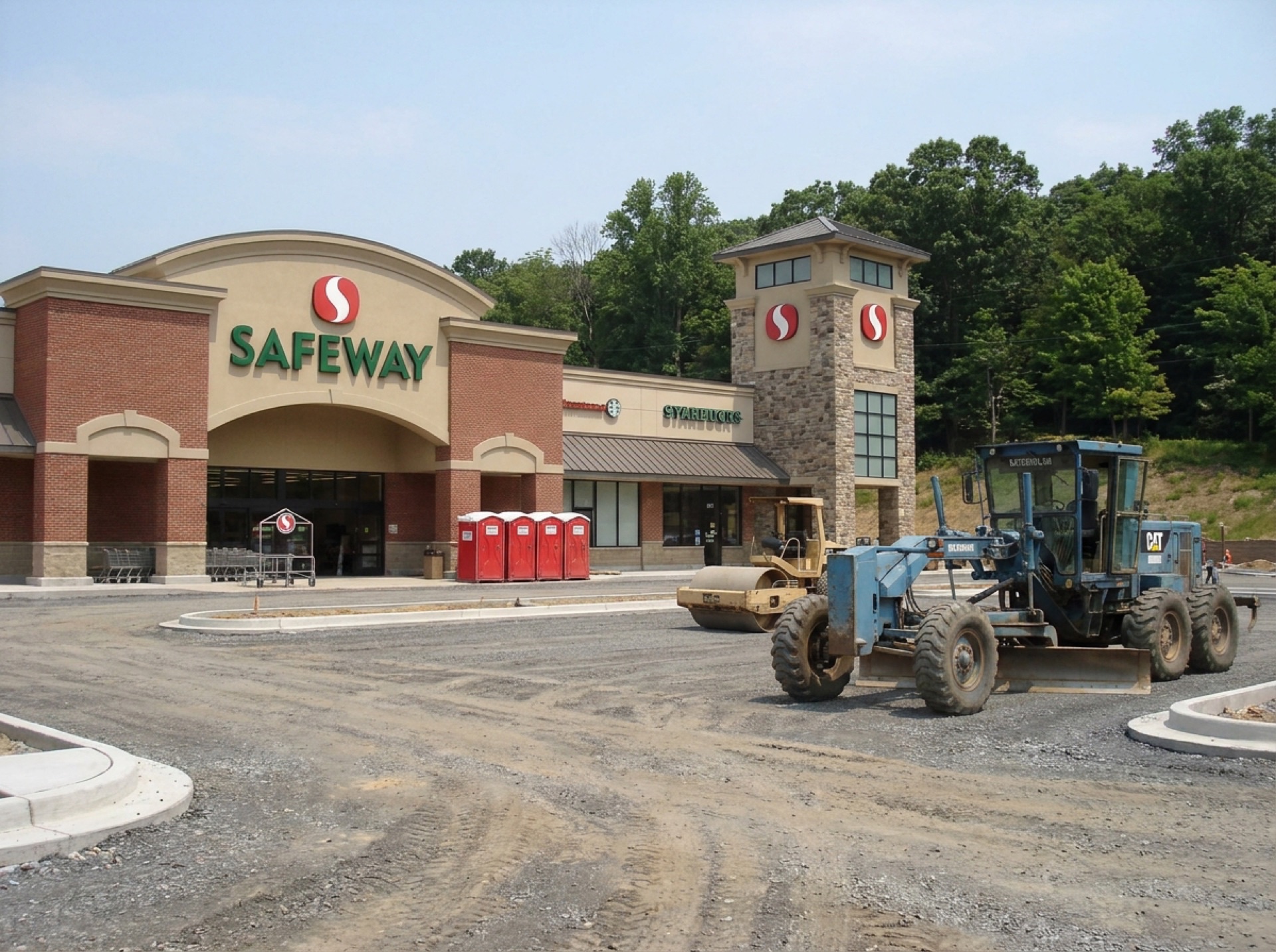
Parking lot resurfacing (overlay only) in Leesburg typically runs $2.50–$4.00 per square foot. Mill-and-overlay runs $3.50–$6.00 per square foot. Full-depth new construction runs $5.00–$10.00+ per square foot depending on drainage requirements and site conditions.
A 10,000 sq ft lot in good base condition would run approximately $25,000–$40,000 for overlay. Cost decreases per square foot as lot size increases due to equipment efficiency.
Typically yes for commercial properties. Loudoun County requires a grading/land disturbance permit for most commercial paving projects, and improvements affecting impervious surface area may require a site plan amendment. We coordinate the permit application through loudoun.gov on your behalf.
Permit lead time in Loudoun County is typically 5–10 business days for routine commercial paving permits. Residential driveways generally don't require permits unless within 100 feet of a stream or floodplain.
Most parking lot paving projects are completed in 1–3 days of active paving once the site is prepared. A 10,000 sq ft lot typically takes 1 full day of paving. A 30,000 sq ft lot takes 2–3 days.
Lot preparation — milling, base repairs, utility work — may add 1–2 days before paving begins. With phased paving, we keep sections of the lot open during work so your business can continue operating. The lot is open to passenger vehicles within 24 hours of paving completion.
Virginia commercial parking lots typically use a two-course asphalt system per VDOT specifications: IM-19.0A (Intermediate Mix, 19mm nominal maximum aggregate size) as the structural base course at 2"–3" compacted thickness, and SM-9.5A Superpave surface course (9.5mm nominal maximum aggregate) at 1.5"–2" compacted thickness. The binder grade for Loudoun County is PG 64S-22, which is formulated for the region's temperature range — 64°C maximum pavement temperature in summer, down to -22°C minimum design temperature in winter. This binder resists rutting in July and August and remains flexible through January freeze-thaw cycles.
Residential driveways typically use SM-9.5A only (no intermediate course) because vehicle loads and lot size are lower.