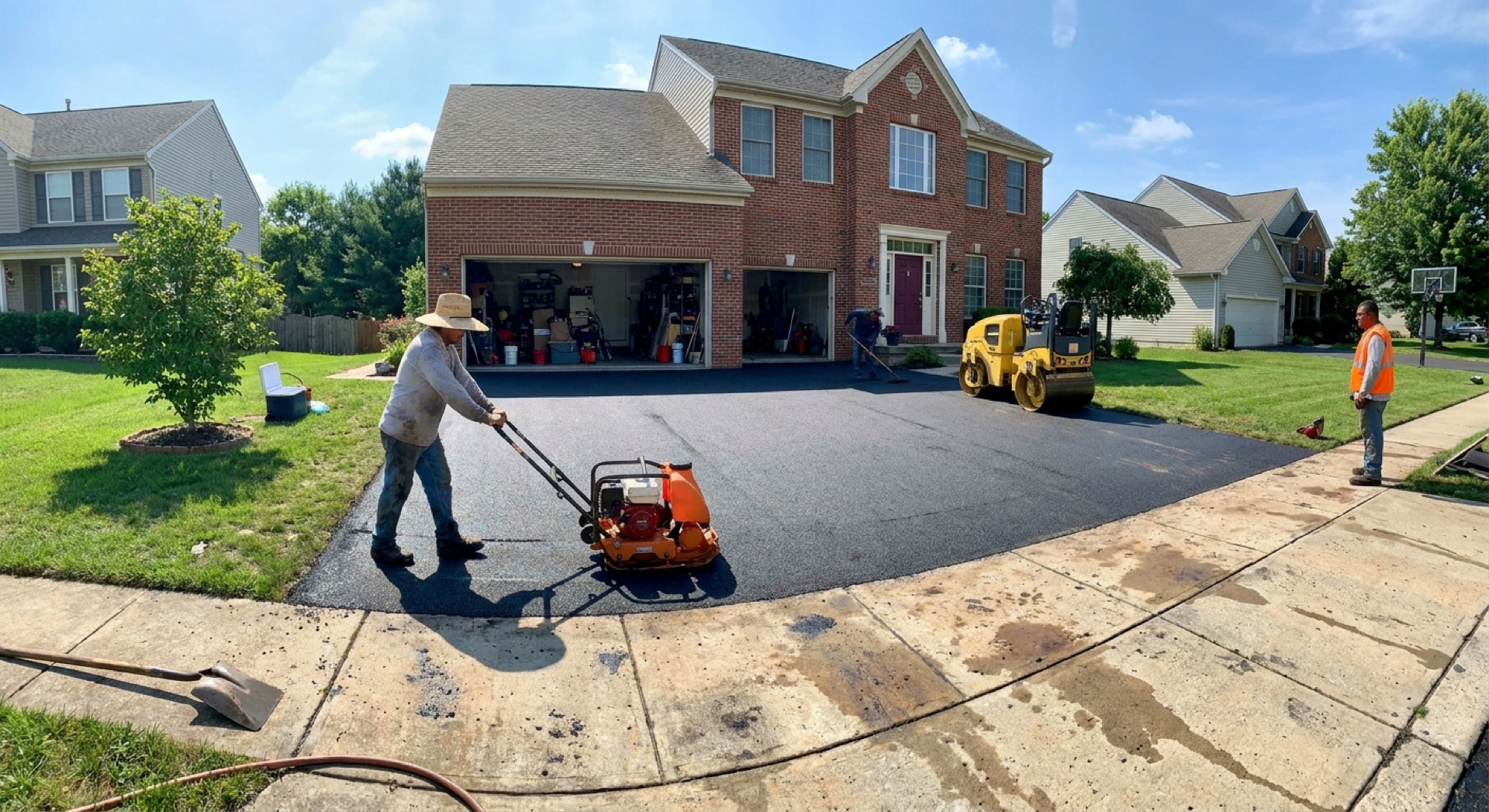
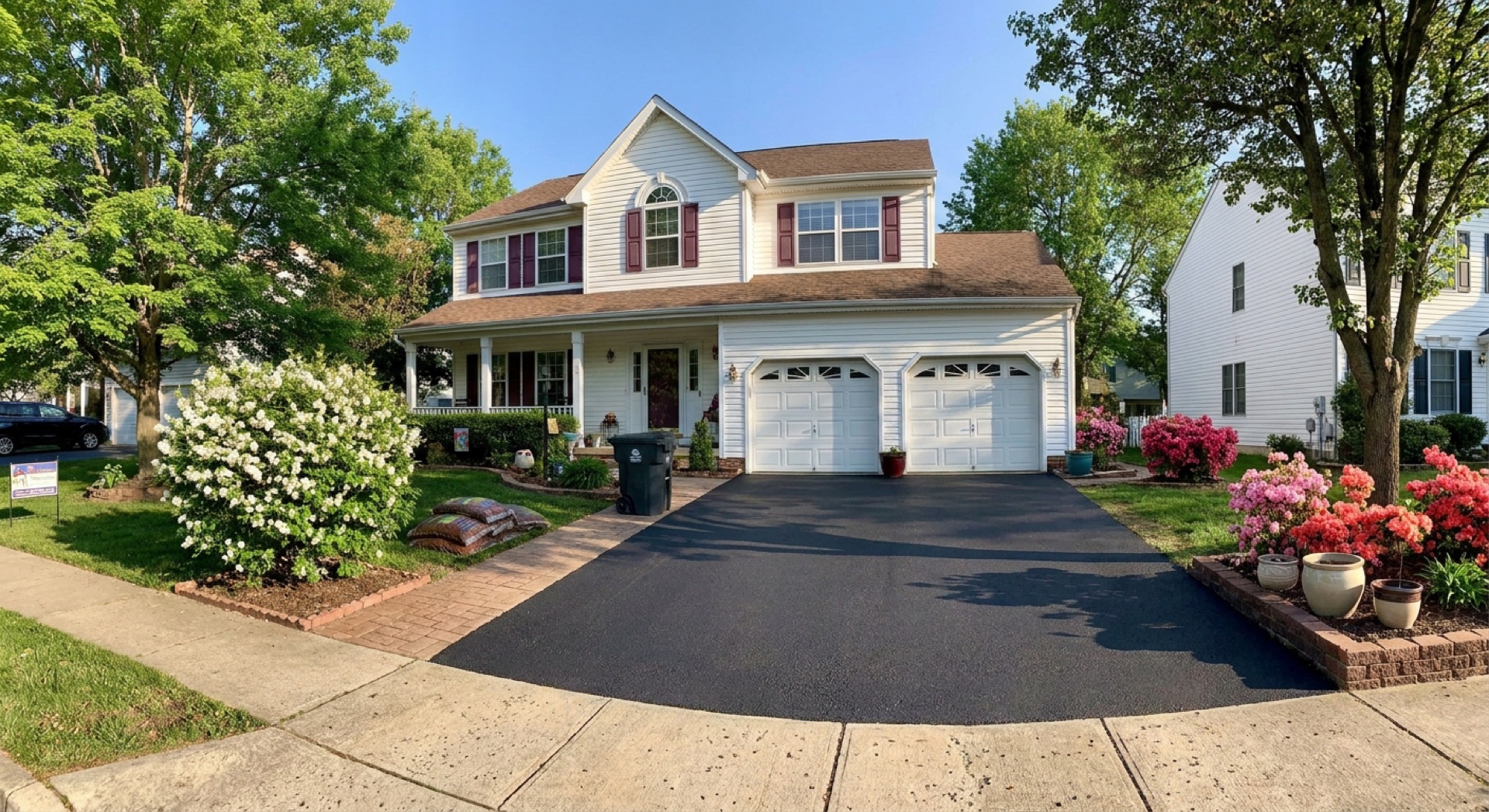
Leesburg Asphalt resurfaces asphalt driveways throughout Loudoun County, VA — removing the failed surface layer by cold milling and replacing it with fresh SM-9.5A Superpave hot-mix bonded with a SS-1h tack coat. Resurfacing covers driveway resurfacing, asphalt overlay, mill-and-overlay, blacktop resurfacing, and surface course replacement for driveways where the existing base remains structurally sound.
Resurfacing costs $3–$7 per sq ft — 40–60% less than full driveway replacement because the existing compacted base is retained. A typical 600 sq ft driveway runs $1,800–$4,200. We assess base condition at every estimate visit before recommending resurfacing vs. full replacement.
Leesburg Asphalt resurfaces driveways throughout Leesburg, VA and Loudoun County — probing base conditions before recommending overlay vs. full replacement, no cold joints, no product shortcuts.
A Wirtgen cold milling machine removes the deteriorated surface 1"–2" deep, leaving a profiled, textured base. The milled material (RAP — Recycled Asphalt Pavement) is 100% recyclable. SS-1h tack coat is applied at 0.08–0.15 gal/sq yd, then fresh SM-9.5A is paved and compacted.
This is the preferred resurfacing method — it removes the failed layer rather than paving over it, and the milling creates a mechanical key for better bond.
When the existing surface is structurally sound but oxidized or showing minor cracking, a straight 1.5"–2" overlay without milling is cost-effective. Tack coat is applied to the existing surface, then SM-9.5A is placed and compacted. Straight overlays are appropriate when: surface cracks are limited and ≤0.5" wide, no alligator cracking is present, and final grade elevation is not a concern (note: overlay raises the driveway surface by 1.5"–2").
Alligator-cracked sections cannot be paved over — the base is compromised and the failure will reflect through any overlay within 1–2 seasons. Leesburg Asphalt saw-cuts and removes each alligator-cracked section, rebuilds the aggregate base, and installs new SM-9.5A hot-patch material. These repaired sections are then overlaid with the rest of the driveway for a seamless finished surface.
Skipping this step is the most common mistake made by low-bid resurfacing contractors.
For driveways where the base has failed uniformly but the material can be recycled in-place, Full-Depth Reclamation (FDR) grinds the existing asphalt and base together, stabilizes the mixed material with cement or lime, and recompacts it as a new base course. A new SM-9.5A surface is then placed on top. FDR is less common on residential driveways but is cost-effective on long private roads and large estate driveways in western Loudoun County.
Resurfacing is the right call when surface failure is present but the base is still sound. These are the signs that put a driveway in the resurfacing window — not full replacement, not just sealcoating.
Linear transverse or longitudinal cracks crossing the surface, oxidation cracking, or scattered hairline patterns that don't connect into an alligator web — these are surface-failure indicators, not base-failure indicators. If the driveway is firm underfoot and there are no sunken or soft spots, the base is likely sound and the surface layer is what needs replacing. This is exactly what resurfacing was designed to fix, at 40–60% of full replacement cost.
Raveling — the loss of aggregate from the asphalt surface — is a clear sign the binder has oxidized to the point where the surface course needs replacement. When you see loose stone, a rough gravely texture across more than half the driveway, or dust from the surface after rain, the oxidized top layer has deteriorated past the point where sealcoating can reverse it. Milling off that layer and placing fresh SM-9.5A restores a sound, sealed surface for another 15–20 years.
Two or three small potholes on an otherwise intact driveway surface often indicate localized surface failure rather than full base failure. When the surrounding areas are firm and crack-free, resurfacing the full driveway — after hot-patching the pothole sections as part of the overlay prep — is more cost-effective than years of individual pothole patches. The overlay ties everything together and eliminates the patching cycle.
Driveways that were graded correctly when installed sometimes develop ponding areas as the surface settles unevenly over time. A mill-and-overlay corrects minor grade deviations by re-establishing proper crown and cross-slope during the paving pass. Drainage that was running off correctly 10 years ago but now pools in the center or low edge is a grade-correction candidate that resurfacing can address without full reconstruction.
Asphalt driveways installed in the early-to-mid 2000s — common in Loudoun County's build-out neighborhoods — are now 15–20 years old. At this age, the surface course has typically completed its useful life while the aggregate base, if properly installed at 6–8" depth, remains fully serviceable. Resurfacing rather than full replacement recognizes the base investment already made and extends it for another generation at a fraction of the cost.
When alligator cracking — the interconnected web pattern that signals base failure — covers less than 25% of the total driveway surface, resurfacing with section repairs is still the right call. Leesburg Asphalt saw-cuts and rebuilds the alligator-cracked sections individually, then overlays the entire driveway. The result is a uniform surface with all failed sections repaired below the overlay.
Full replacement becomes necessary when alligator cracking covers more than 25%, indicating widespread base compromise.
We probe base firmness, assess crack patterns, and check for subsidence. If the base is sound, we recommend resurfacing. If the base is soft or alligator cracking covers more than 25% of the surface, we'll tell you that resurfacing won't last and full replacement is the right call.
We'd rather give honest advice than take a job that will fail.
Failed sections are saw-cut, excavated, and hot-patched. The Wirtgen cold milling machine then removes the existing surface 1"–2" deep across the full driveway area. Milled material is swept and hauled off.
Total milling depth is verified with a straightedge before proceeding.
SS-1h asphalt emulsion tack coat is applied by distributor bar at 0.08–0.15 gal/sq yd and allowed to break (turn from brown to black, 10–20 minutes). Fresh SM-9.5A is then paved at 1.5"–2" loose depth and compacted to 1.5" finished thickness and 95% of theoretical maximum density.
Edges are cleanly defined and any transition points to existing pavement or concrete are hand-worked. Full site cleanup. Driveable in 24–48 hours.
First sealcoat should wait 6–12 months for the new surface to fully cure before sealing.
All pricing reflects Loudoun County market rates (25–35% above VA state average). Final cost depends on extent of section repairs required. Call (703) 382-5769 for a free on-site estimate.
Leesburg Asphalt assesses every driveway honestly. We'll recommend resurfacing when that's the right call, and replacement when it isn't — we don't push the more expensive option when resurfacing will solve the problem.
The resurfacing market in Loudoun County is unique compared to most Northern Virginia counties because of the sheer concentration of driveways that are now hitting their first resurfacing window simultaneously. Most of eastern Loudoun's residential housing stock — Broadlands, Brambleton, South Riding, Cascades, Lansdowne, and the Ashburn corridor — was built between 1990 and 2010. Driveways installed with those homes received 1.5"–2" asphalt surface courses that were adequate at installation but are now 15–35 years old, many without consistent sealcoating or maintenance.
The result is a significant wave of resurfacing projects concentrated in communities that built out during the same era. For homeowners in these neighborhoods, resurfacing is almost always the right first conversation — if the base was properly installed, it likely still has full serviceability and full replacement would waste that investment.
Western Loudoun presents a different resurfacing profile. Farm roads, estate driveways, and rural residential drives in Purcellville, Hamilton, Middleburg, and Round Hill tend to be longer, less well-documented, and sometimes originally paved with thinner specifications or chip seal that was later overlaid. Resurfacing in western Loudoun often requires more base assessment work before a recommendation can be made — base depths vary widely, drainage conditions are more complex, and VDOT entrance coordination is more commonly involved.
Leesburg Asphalt handles both markets: the eastern Loudoun subdivision resurfacing volume and the more custom-engineered western Loudoun estate and rural road work. Every project starts with the same honest base assessment, because a resurfacing job on a bad base is a waste of your money regardless of zip code.
First, the deteriorated surface is cold-milled 1"–2" deep using a Wirtgen cold planer — this removes the failed surface while preserving the solid base. The milled material (RAP — Recycled Asphalt Pavement) is swept clean and hauled off for recycling. A SS-1h tack coat is applied to the cleaned surface at 0.08–0.15 gallons per square yard to bond the new layer.
Fresh SM-9.5A Superpave surface course is then paved and compacted to 95% theoretical maximum density. The result matches the finished grade and drains correctly.
A properly executed mill-and-overlay on a sound base typically lasts 15–20 years in Loudoun County with regular sealcoating every 3 years. A straight overlay (no milling) on a solid but oxidized surface typically lasts 10–15 years. Both estimates assume the underlying base is intact and properly compacted at installation — a resurfacing job on a failing base will begin showing stress cracking at 3–5 years as the base problems reflect through the new surface layer.
This is why the base assessment before recommending resurfacing is the most critical part of the process.
A freshly resurfaced driveway is typically drivable 24–48 hours after paving, when air temperatures are above 70°F and conditions are sunny. In cooler or overcast conditions, allow 48–72 hours before driving on it. Avoid turning sharply or stopping abruptly on the new surface for the first 2–3 weeks — the asphalt continues to cure and gain strength over the first 6–12 months.
Do not apply a sealcoat until at least 6 months after resurfacing; the new surface needs time to off-gas petroleum oils before sealer is applied over it.